Tag: Rants

  • I hate Secret Santa

    Imagethief likes the holiday season. He is not one of those December curmudgeons who bah-humbugs his way through Christmas. Give me trees, tinsel, candy canes and a big dinner with my friends. My dad used to roast a goose for Christmas. How traditional is that? And we’re Jewish.

    There is, however, one Christmas tradition that I dread every year, and that never gets any easier to deal with. That is the office “secret Santa” program.

    Anyone who works in a large office probably endures something similar. The way it works in our office is that the office assistant walks around with a box from which you draw the name of a colleague. You then have to buy that person a gift for under 50RMB. The gifts are all presented at a Christmas party at which Santa Clause, played by the white guy who most recently joined the company, calls each person up one-by-one to receive his or her anonymous gift. I did the Santa gig myself my first Christmas with the company, three years ago, and spent a miserable, hot, itchy two hours in the Santa suit pulling artificial whiskers out of my mouth while my colleagues, sat on my lap one by one. Someone else will be pulling those same spit-encrusted whiskers out of his mouth this year.

    I would play Santa every year if I could only get out of the gift-giving, though.

    The problem is that we are a fairly big company and I inevitably draw the name of someone I don’t know. This is a pain because if it’s a friend you have two decent options: either you have some idea of their tastes and you can get something you will be reasonably sure they will like; or you can get them a gag gift and be confident they won’t take the wrong way.

    But I never, ever draw the name of someone I know well. I always get the shy, new, Chinese girl who doesn’t talk and whom nobody knows. I have a 100% perfect track record of this. And I know most of the people in the company (although given that I just spent ten months in Shanghai there is a slightly higher proportion of unfamiliar faces than normal). It’s like they’re rigging the draw on me.

    In fact, I learned this year that some of my colleagues were re-drawing until they picked the name of someone they knew. I had no idea such a thing was allowed or I would have gamed my own draw. Some people in are office are easy to buy for, such as the company driver (baijiu). But, no, I had to play by the rules and ended up with a new girl who works way at the other end of the office and who has a spartan desk that reveals nothing about her life, loves, hopes, pets, celebrity crushes, get-even list, or anything else that might be remotely useful in picking a gift.

    Not that with 50RMB to spend I could get all that creative. Our offices are in Oriental Plaza, which features a mall where the list of things that can be purchased for under RMB50 is this long:

    • Dumplings.

    Trust me: You don’t want to leave a box of gift wrapped dumplings under the tree for too long, unless you want to deck the halls with vomit on Christmas morning.

    Thus inspired, I invariably procrastinate my purchase until the last possible minute and then end up in one of two places: Watsons or the “Ole!” supermarket. There I end up contemplating the usual range of naff or inappropriate possibilities. Doraemon shampoo? Nahh, toiletries are too personal. Who knows what fragrance this girl likes? Condoms? I don’t want to be hacked to death by her family And anyway, the Japanese ones are RMB75 and thus over the budget. Muesli? Nail polish? Stationery? A fake Rolex? (You have to go outside to buy this.) None of it seems very exciting. And the western get-out-of-Christmas-jail-free card, the gift certificate, doesn’t really seem to exist here.

    I actually thought about breaking the rules this year and spending semi-lavishly just for the hell of it. Why not buy her a real Swatch or Casio watch? Or an iPod Nano? Or a sexy mobile phone? That would rock the party. But it might also kindle jealousy, dangerous recriminations or the (wrong) assumption that a certain Santa was on the make. The program might be “anonymous”, but even a fairly retarded detective could identify the offending Santa by simple elimination. This is especially true as secret Santas tend to out themselves at the party unless they are particularly ashamed of their gifts.

    Faced with these undesirable options I elect to punt: I buy candy. At least, my theory goes, she can share it with her teammates if she doesn’t like it. Having become acquainted with the strange, Chinese fascination for a certain kind of imported candy, and mind controlled by the miles of it on display, I made the inevitable choice. Ironically, even though I have a world-beating sweet tooth inherited from my English, goose-roasting father, I hate this particular candy. How pathetic is that? I  bought this poor girl whom I don’t even know candy that I can’t stand because I was too creatively bankrupt to come up with a better choice. Merry freakin’ Christmas.

    To make this situation extra tragic, I have one-and-a-half boxes of this same candy sitting at home. They were brought over to my house by one of my colleagues when I had a team dinner recently. But these were in a distinctively shaped package, and I didn’t want to give the same configuration, lest my naked re-gifting ploy be spotted. Those candies are destined for my ahyi. She’s from Anhui. She’ll eat anything. Or, more likely, huishou it for cash.

    So bought an RMB45 box of candy I already had and put in a gift bag that cost another RMB20, thus putting me over the limit but, I figure, allowing me to squeak by on a technicality as the bag isn’t technically the gift. I probably should have given her an envelope with cash in it.

    I console myself with the thought that most of my colleagues, Chinese and foreign, aren’t much better at this than me. While buying my “gift” today I bumped into another colleague who was on the same mission. She, however, opted for default choice two, different famous candy brand. A couple of years ago one colleague of mine was so unimpressed with her secret Santa gift –which I won’t describe here for fear of driving someone to suicide– that she “forgot” it in the back of a taxi on the way home from the party. It wasn’t even worth passing to her ahyi. It was that bad.

    At least I have this burdensome task dealt with for another year. But I’ll be on a plane back from a meeting in Japan during this year’s Christmas party. That’s a shame because, secret Santa aside, I genuinely enjoy the Christmas party. But at least I won’t be there to see the look of numb indifference on my colleague’s face when she becomes the 20th person that evening to receive a box of the same candy.

    Ho, ho, ho.

    Note: Slightly edited from the original to add some deniability.
  • Further adventures in glamorous international travel

    Having arrived in Macau, the romance continues. First was immigration, where the lines crawled as officers stamped arriving passengers in with the indifferent sloth that seemed circa Vietnam, 1996. My immigration officer painstakingly inspected every stamp in my generously stamped passport. It’s Macau. There are only two reasons why I would be coming: The GSM Asia Congress or to gamble. And it ain’t to gamble.

    Still, Imagethief has always believed that if there is one overarching indicator of a destination’s civility it’s whether the taxis are metered. On that count, Macau is the pinnacle of gentrification while Kuala Lumpur, for example, which has much to recommend it aside from its Taxis, is Gomorrah. There was some language struggle with the taxi driver, but between his Cantonese and my Mandarin I got to the hotel. The five minute drive cost a walloping 38 patacas, a pataca being the Macanese currency, for all intents and purposes a Hong Kong dollar with a silly name. In fact, “pataca” will now replace “zloty” as my general label for ridiculous currencies, e.g. the plummeting US pataca.

    On further reflection perhaps that’s unfair. The pataca is at least holding its value.

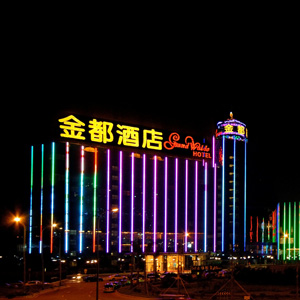
    So the taxi driver got me to my hotel, but I rather wish he hadn’t. The name, “Grand Waldo”, should have tipped me off. Seriously: Grand Waldo? In the shadow of the grandeur and surreal artificiality of the Venetian, the “Grand Waldo”, or “金都” to use its pretentious Chinese name, compensates by having the gaudiest exterior lighting in all of Macau. And that’s saying something. I had actually noticed it from the airplane on the way in, never dreaming that this was where I was headed for.

    The lobby had a touch of desolation about it, a moody silence punctuated by breathy snapping of a nailgun as some evening renovation work was carried out. At the desk, three attendants went through a check-in routine that was even more laborious and sluggish than Macau immigration.

    When I arrived at the desk the woman who was supposed to serve me was distracted first by the need to send a fax to someone, which task took about five minutes, and then by the arrival of a disgruntled man who wanted to complain at length about the crappy service. He was eventually foisted off on the assistant manager, but as I went through check in I listened to his litany of complaints. It ended with him canceling his stay in leaving in search of another hotel. Not a good sign.

    Nevertheless, I toughed it out. My room was reasonably sized, and artfully positioned in an armpit of the building such that the maximum amount of the scintillating external lighting shined right in. Fortunately there were blackout curtains.

    There was no CNN or BBC, but it did have Fox News (did you know that curvy women have smarter children and Virginia is the state with the most personalized license plates?) and, thank heavens, Al Jazeera (gunfire and political tension between Fatah and Hamas in Gaza, major fire in London). It also had Portuguese soap operas featuring attractive, heavy-breasted women in various states of emotional turmoil and scanty dress. That was worth something.

    I dialed room service. I’m pretty sure I dialed correctly because I pressed the button labeled “room service” on the phone. This led to a Kafkaesque phone nightmare in which I was transferred no fewer than six times before I got someone who was prepared to take an order for a club sandwich. 82.5 patacas after tax. The man who brought it to my room wouldn’t allow me to sign for it. I had to pay cash. He didn’t offer to make change for the pataca C-note I handed him. He just grinned and pointed at himself. I was so amazed by this display of chutzpah that he was long gone before I realized he hadn’t left the receipt for me.

    An hour later the phone in room rang. “Hi, I was staying in room 620* before, and I think I left a blue comb in there, in the small bathroom.” (It’s a suite.) “Can I come and get it?” This sounded a lot like, “Businessman gets rolled in Macau hotel” to me. I said I’d check in the bathroom. Sure enough there was a blue comb in the bathroom with bits of gel stuck to it. I told the caller to come on down and put the chain on the door.

    So he had checked out of this room and into some other room in the hotel and left his comb. Housekeeping had flipped the room, but somehow not noticed the grungy, used comb in the outer bathroom. Meanwhile, this guy was so attached to his plastic comb that he turned up his nose at the one included in the room amenity kit and came back for his.

    The icy tendrils of paranoia began to creep up my neck.

    At any rate, the comb owner was apologetic enough when he showed up at my door, and made no attempt to roll me or sell me a blow job (which does rather distinguish him from a hotel experience I once had in the aforementioned Kuala Lumpur, but more on James Bond Massage and Fullsex Escort Service and the Cantonese hookers I had to pay to go away some other time).

    So it’s all quiet now, and at least the broadband works, as I type here in the glow of Al Jazeera (which isn’t half bad).

    I have, however asked my coordinator to look for another hotel for tomorrow night.

    *Not my real room number. Like I said, tendrils of paranoia.

    Update: Hanging on my room door this morning: The Oriental Daily News, which appears to be a Hong Kong gutter rag that, judging from the layout, is designed for a readership devoted to hard hitting stories about police shootings and starlet misadventures. Still, I suppose it gives you something to read while you yank the crank on your one-armed bandit. You could just about finish a story in the time the wheels take to come up, “Bull’s eye”, “Clown” and “Dog riding a tricycle” or whatever symbols they put on slot machines these days (Imagethief is not a gambling man). I guess the name “William Moss” and the US passport didn’t tip them off.

    In all its pomp...
    In all its pomp…
  • Stupidvator

    One of the fine things about moving to a new city is that you always encounter something you’ve never seen before. In Shanghai I experienced the thriving majesty of the Huangpu river, the early-morning army of huishou men and women that prowl the city with bells made of pot lids, the glittering towers of Pudong (better from a distance), and the shady intimacy of the French Concession. Less charmingly, I also experienced the most annoying elevator ever made.

    I’ve been riding elevators for many years and I like to claim a fair mastery of their use. I am not mystified by their operation, don’t think they are magic, and am pretty sure that I am not being teleported when I use one. When an elevator door closes on a car packed with people and opens to emptiness, I don’t assume the passengers have been disintegrated or dumped into a pool of crocodiles (although from time to time I have wished for that). Rather, I assume they have debarked conveniently upon the floors of their choosing. Yep, elevators and I are old and trusted friends.

    Until now. In Shanghai I stumbled upon a type of elevator I had never seen before. An elevator that rewrites fundamentals of how one summons and uses an elevator. An elevator that shifts not only people, but paradigms of elevator operation.

    It also lives in my apartment building and annoys me no end.

    The difference is deceptively simple. Instead of a call button on the outside and an array of floor selection buttons on the inside, our elevator has a single calculator-style keypad on the outside. The keypad serves two elevator shafts. To summon an elevator one presses the button or buttons for the desired floor. I live on the seventh floor, so I press “7″. If I lived on the 19th floor (I can but dream) I would press “1″ then “9″. The LCD panel acknowledges my input and flashes an arrow to show which shaft I should wait by. If I enter an invalid floor number like 968 (don’t think I haven’t tried), I get a demure “?” in return.

    When the elevator arrives, an LED panel inside the inner door frame shows which floors the car will be stopping so you can verify that you have in fact waited by the correct shaft as directed.

    Simple, no?

    No. This is a perfect example of taking an elegant, robust, time-tested system and over-engineering it into finicky obnoxiousness. Thank you, Schindler Elevator Corp, for gifting this upon the world.

    First of all, no elevator should need an A4-sized plaque of directions explaining how to use it, but that’s what our elevator has. Apparently it confuses enough old people and children that the instructions were necessary. Perhaps people were just piling up in the lobby. I can explain normal elevator usage in four bullet points, just in case I happen to run into a Shipibo tribal elder in the lobby of a building:

    1. Press the call button
    2. When the elevator arrives, step inside
    3. Press the button for the desired floor
    4. When you arrive at the desired floor, as indicated by the display, get out

    But this elevator needs illustrations and arrows to make clear its method of operation.

    Imagethief presumes the select-floor-first method of elevator operation is supposed to speed things up. If everyone waiting for an elevator has selected a floor already, a mighty electronic brain somewhere in the bowels of the building can super-compute an elevator routing solution of maximum efficiency. But our buildings supercomputing brain must have blown a tube because our elevators take forever to show up. I think, freed from the simple linear order of normal elevator operation, the brain gets hung up on some kind of neurosis. Sure I could get the kids in the lobby now, but that auntie on twelve is only going two floors…What do I do? Confronted with this strategic calculation, it elects to punt. It’s just one more example of how much a single bad algorithm can fuck up your day.

    And there are some other disadvantages to the system.

    First, let’s say you’re running for a normal elevator. As long as you make it through the door, you’re home free. You can press the button for your desired floor at leisure. You can even set down your groceries to do it. But with our elevator that doesn’t work. You’ve got to get your floor entered before you step on, which means speedy key work before the doors close, or jamming a hand in to open the doors and then entering the floor outside while everyone else waits. Trust me, when you’re all flustered from your run and have ten pounds of cat litter hanging from one wrist and thirty eggs from the other, a fast floor-entry isn’t as easy as it seems.

    This situation is aggravated if there are several people scrambling because each person has to enter his or her floor outside as well. Unlike a traditional elevator where as many people can press buttons as can simultaneously get their grubby little fingers near the panel, this system is strictly one-at-a-time. We have more than twenty floors, so at peak period this can take a while. Queue up.

    Of course, when you’re in a hurry you sometimes sacrifice some accuracy. Thus when going down I have entered “11″ or “12″ instead of “1″ on a couple of occasions. Tough luck. I’m committed. And if you step inside the car before you notice, there is no bailout option. You can’t press the button for the next floor along and make a graceful exit. It’s the round-trip.

    Furthermore, I have been conditioned for the past 39 years to press a floor button after I get on the elevator. I just can’t shake this habit. After I step into my building’s elevator I have to suppress the desire to jam my index finger into the bare, stainless steel repeatedly. People in my building already think I am wierd enough and anything more is likely to scare them. I suppose I could stab the “close door” button, but I have already conditioned myself to avoid that because nothing annoys me more than passengers who want to “drive” the elevator, and spend their time working the “open door” and “close door” buttons repeatedly.

    There is also a social aspect to the process as well. We all get in; we all enter our floors; and we all enjoy the cameraderie of the elevator. Everybody knows who is going where. None of this cryptic skulking by the panel outside.

    This is all just one more sign that I am getting old and increasingly reject newfangled “conveniences” that disrupt my entrenched habits. You say “iPod”. I say radioactive brain-scrambler. So be it. I welcome crankiness, and you can expect more of it as I confront my inevitable 40th birthday and propulsion into actual adulthood (I’ve been procrastinating it successfully so far).

    In that spirit I’d like to go beyond criticizing my apartment’s elevators and say that I reject the idea of electronic controls for elevators completely. I’ve had it with blinking lights and fabulous electro-conductive buttons with ethereal, blue lighting like the elevators at my office (they light up for nothing; don’t even look at the button for a floor you don’t want to stop on). I want my elevators controlled by a person. And not one of those sullen girls who operate the elevators in old apartment buildings in Beijing. They can’t be bothered to look up from their books, and they knock off at midnight forcing you to walk down ungodly flights of stairs on your way home from late-night beer-swilling sessions with Chinese friends. I want no part of that. I want my elevator operated by a height-impaired man named “Rudy” who wears a velvet waistcoat and a fez and who salutes when I enter the car. This is China; shouldn’t be too hard to arrange.

    And as long as I am complaining, what is it with bathroom icons in bars? I’ve been seeing a lot of “pipes” and “high-heeled shoes” to indicate men’s and ladies’ rooms these days. This is totally unsatisfactory. What are you supposed to do if you’re a pipe-smoking woman? Or a drag queen in heels? What about if you are pipe-smoking drag queen? You might simply give up in confused frustration and take a leak in the hallway. I don’t know about you, but stumbling across a pipe-smoking drag queen taking a leak in the hallway throws me off my game. And I grew up in San Francisco’s Castro district in the seventies. Let’s not encourage it in Xintiandi.

  • Apartmental, a part mental

    As regular readers will know, Imagethief has been on cross-assignment to his company’s Shanghai office in recent weeks. The company is, meanwhile, attempting to persuade me to consider semi-permanent reassignment to Shanghai. I have not yet made a decision about this (and if my landlord in Beijing is reading this, we’ll talk).

    In general, I really like the company I work for. They’ve taken good care of me, provided training, put up with my idiosyncrasies, and were patient with me while I spent my early months wrapping my head around the cataclysmic, nationwide fun-house that is the Chinese media. Because of that I was willing to listen to when they suggested that relocation to Shanghai might be good for my professional development.

    They say that whichever Chinese city you come to first is the one you build an attachment to. I suppose this argument might break down if your first port of call was Linfen. But I came to Beijing by choice, and I’ve certainly become affectionate for the city. Beijing, for all its impersonal ministries and immense boulevards, has an intimacy and a grungy, eccentric streak that really appeals to me. In a little under three years, I’ve really come to think of Beijing as home.

    It doesn’t hurt that I’ve been surrounded by old Beijing-hands who are naturally contemptuous of Shanghai (Schwankert, I’m talking about you), or that I’ve been writing about the city’s eccentricities for That’s Beijing semi-regularly. So I came to Shanghai with the casual, Shanghai? Pfeh! disdain of the confirmed Beijinger.

    Imagine my surprise at discovering that Shanghai is really not bad at all. It has a very different feel than Beijing, for sure. As David Wolf said to me over lunch Friday, in explaining the difference, “Beijing was created to be an imperial capital. It has always been a Chinese city. Shanghai was created to be a treaty port, and foreigners have always been a part of its identity.” He also advised me to make regular trips back to Beijing for sanity checks. Fair enough. But I’ve quite enjoyed the time I’ve been spending in Shanghai, and the city has its own personality and charm, if that is the word to use. My office and apartment are both in a very pleasant part of town, which does help.

    Speaking of my apartment, however, I have some complaints.

    The company provided the apartment for me to use during my cross-assignment. A previous expatriate employee of ours had lived in it for about four months and had then left China. The week before my Christmas break I had quick look in the apartment to see if it was habitable. It was, depending upon your point of view, a relatively high-end local apartment, or a relatively low-end international apartment. Perhaps the latter, given that it had international cable TV channels. It had plenty of room for me and occasional visits from Mrs. Imagethief. My conclusion was that it was generally fine, although I would have to bring some bedding from Singapore. I told our Shanghai office manager she didn’t need to have an ahyi work it over before my return. That was an inexcusable, rookie error. What can I say? It was night, I was rushed. My due diligence was not superb.

    I returned from my Christmas vacation in the US on Saturday, January 6th. On the 7th I flew to Shanghai and went straight to the apartment. There, alone with a suitcase in the dark of a Shanghai winter evening, jetlagged into irascibility, the flimsiness of my earlier appraisal became clear. As did the bachelor existence of the previous occupant. I had not bothered to open the refrigerator during my brief, pre-Christmas visit. Monumental mistake. The entire contents consisted of two rotting, three-week old pieces of meat and a box of Ferrero Rocher candies now infused with the smell of decaying flesh. The rest of the food supply was two things of instant noodles and a huge pile of little sugar sachets stolen from every restaurant and bar in the French Concession.

    Three years ago when I first moved to China and did my Wordlink Education language program, they put me up in a very similar two-bedroom apartment. It was fine, but made no provision for the fact that some people might like to cook and eat at home. The total kitchen implements consisted of a frying pan, a chopper, a cutting board, two bowls, two Chinese soup spoons (the boat-shaped ceramic ones that are hard to use for sugaring coffee) and some chopsticks. I had to go down to the CRC supermarket in Wudaokou’s Huaqing Jiayuan apartments and buy a saucepan, fork, knife, round-bottomed pan, plastic colander and a plate. (And I only got this far after several tragic days of trying to eat salad with chopsticks. Oil-slicked cherry tomatoes are a bitch to eat with chopsticks, no matter how dexterous you are.)

    Buying forks and can-openers when you’re in the heady rush of fresh-arrival and wide-eyed, goldang, lookit that! culture-shock is fine. It’s all part of the adventure. And I was surrounded by threadbare college students, so living like one was a blast of juvenile nostalgia. I went through a somewhat more substantial stocking of my own apartment in Beijing some months later, culminating in the shipping of my accumulated household worth of stuff from Singapore when my move to China become final.

    You forget when you’ve lived in a house or apartment for a while just how much stuff accumulates. Some of it is junk, but some of it is really useful. The great thing about my apartment in Beijing is that it has everything I need (and plenty that I don’t): Dishes, utensils, tools, cables, connectors, bric-a-brac, Q-Tips, spare Kleenex, nail clippers, scissors, scotch tape, shoe polish, laundry detergent, a sewing kit, and so on off into infinity. The apartment in Shanghai had a wok, four bowls, four plates, Chinese spoons, chopsticks, a chopper and cutting boards. It also had, inexplicably, an upright piano. I don’t play piano.

    Barring the piano, this was so close to the contents of my Wudaokou apartment that for a moment I thought I had slipped back in time.

    And here is where I get cranky. I am now thirty-nine and a (semi) respected China business professional. I have lived here for three years. My wife and pets are here. I have a network. I can get around in Chinese. I did not want to have to relive my starving student days by buying a fucking can opener. I believe that if you are trying to woo someone into uprooting themselves from city A and shipping their wife, worldly possessions and fuzzy kitty cats to city B, you need to do everything possible to make that person think city B is paradise on earth. Three months in a luxurious service apartment refreshingly free of carrion and stocked to the gills with conveniences seems like a good place to start. Once they sign on the dotted line you can always pull a bait-and-switch. But remember, it’s bait first then switch.

    I also had to come to grips with the legendary consequences of the south-of-the -Yangtze government heating edict. This is one of those remnants of central planning that make China fascinating at an academic level and a pain in the ass at a practical one. My apartment in Beijing seals like a spaceship (although, like a spaceship, you can also run out of air and die if you don’t ventilate it from time to time). I don’t even need to turn the marvelous central-heat on. The apartment stores solar energy.

    My temporary Shanghai apartment, however, leaks like a straw hat and is apparently heated by a small man from Guangxi who rubs sticks together somewhere in the duct-work above the ceilings. At least that’s what it sounds like. He needs to rub the sticks together for four or five hours before they generate enough heat so that my breath doesn’t fog in the living room. I needed to sort out the arcane timing system which is based on oracle bones and bedsprings. Apparently I am supposed to set the timer to turn the heat on about one hour after I leave the house in the morning. That will ensure that the apartment is damply tepid about the time I get home, rather than arctic. I think the answer is a vastly larger television that would generate supplemental heat, but for some reason the company isn’t buying my arguments.

    I can’t imagine why not.

  • Fly the feces-free skies of China Southern

    Few things have provided more grist for Imagethief’s gripemill than Chinese airlines. A simple search of this website for various permutations of China+Airline+Travel will make that abundantly clear. In part this hostility is unfair. Chinese airlines are every bit as good as American carriers –although I have heaped scorn on those as well– and in some ways they are distinctly better. For instance, I would recommend Chinese carriers to anyone with a fetish for being waited upon by attractive Asian women as opposed to a fetish for being snarled at by hostile, matronly Americans. Not that no one has that particular fetish, its just that its somewhat more eccentric and self-destructive, like a fetish for self-mutilation, blender worship or Paris Hilton.

    And of course, Chinese carriers are every bit as successful as their American counterparts, which is to say they are losing money hand over fist. That’s why I was constipated to readin a Reuters news story (quoting Xinhua) about some of the money-saving steps recently suggested by China Southern Airlines:

    A Chinese airline has calculated that it takes a litre of fuel to flush the toilet at 30,000 feet and is urging passengers to go to the bathroom before they board.

    As Chinese airlines come under increasing pressure to cut fuel expenditures, China Southern’s latest strategy is to encourage passengers “to spend their pennies before boarding the aircraft”, Xinhua news agency reported on Thursday.

    “The energy used in one flush is enough for an economical car to run at least 10 kilometres,” Captain Liu Zhiyuan, who flies regularly between Hangzhou and Beijing, was quoted as saying.

    Citing a survey by the company’s logistics department, Liu said carrying one kilogram of items such as blankets and pillows by air for one hour uses 0.2 kg of fuel.

    “This means the blankets and pillows on board the aircraft eat up 60 tonnes of fuel every day. If each seat is loaded with three 450-gram magazines, another 60 tonnes will be consumed,” Liu explained.

    Well, having taken many flights on China Southern over the past few years, I can tell you that many passengers already consider flushing optional, so it’s debatable how much value such a program might have. I also think that the focus on flushing perhaps ignores the root of the problem, which is that according to this article, airplane toilets are some of the least energy efficient devices on the planet, on a part with M1-Abrams tanks and arc lights. Airplane manufacturers may want to get cracking on this (so to speak). After all, if my home toilet required a liter of kerosene for every flush, I’d just use half the kerosene to burn our daily household quota of excreta in our apartment building’s courtyard (everyone loves a bonfire) and sell the rest on the aviation fuel black market for cold, hard cashola.

    But as the article makes clear, cracking down (again, so to speak) on online flushing is really only part of the solution. The real triumph would be to encourage people not to carry any bodily wastes on board the airplane at all. In fact, I think the “pillows and magazines” in this article are really offered as a gentle metaphor for the collection of excreta sloshing around inside of each of us. After all, to the airline, the accumulated fecal matter fermenting in your bowel is just another form of carry-on luggage, and one that they have no control over. And nothing chafes an airline more than the thought that you might be gaming their system. Turds are just the beginning. Next thing you know people will be wrapping their duty free purchases in condoms and swallowing them to evade carry on limits.

    Let’s look at this scientifically. Doing some quick research, I note from a highly credible source, the movie Beverly Hills Cop, that the gut of the average American fifty-year-old contains about five pounds (2.25 kilos) of undigested red meat. Chinese are not Americans, but they are eating an increasing amount of red meat so let’s use American fifty-year-olds as proxies for the entire Chinese population and go with that number. It’s this spirit of daring scientific inquiry that led to such breakthroughs as cold fusion and Dr. Hang Woo-suk’s cloning program at Seoul National University. Going further I also note that China Southern is one of the airlines that has ordered A380s, which can carry up to 500 passengers. After performing some complex and rigorous calculations far beyond the reach of lesser cortexes, I discover that a single planeload may be hauling around up to 2500 pounds (1,136 kilos) of turds.

    Shocking. If the fuel consumption figures in the article above are accurate, that means that China Southern’s A380s could burn up to 227 extra liters of fuel an hour just dragging around surplus shit. On a twelve-hour long-haul to San Francisco that could mean almost 3000 extra liters of fuel consumed in the name of turd-haulage. Add on another three flushes (conservatively) per person on that same flight and you are looking at another 1500 liters of fuel consumed, for a total of 4500 kilos of fossil fuels –1.5% of the aircraft’stotal fuel capacity– flushed away in the name of airborne waste management. My god, people, haven’t you heard of global warming?

    Looked at this way, you can see that China Southern might be onto something. In fact, they might taking too conservative an approach to managing this situation. In the interest of safeguarding this planet that we all share, Imagethief proposes that, like hair gel and toothpaste in the US, human fecal matter be banned from all Chinese flights. Passengers should be required to consume a heavy dose of laxatives the day before flying and to purge thoroughly before boarding. Enema lounges could be installed in all Chinese airports, helping passengers to unburden themselves their ungreen load before boarding. I find a pre-flight high colonic highly refreshing myself, and imagine that it could become quite the fad. Naturally, pre-boarding security questions should be amended:

    • Did you pack your bags yourself?
    • Has anyone else handled your luggage since you packed it?
    • Did you have a nice, big shit this morning?

    With a few simple steps like this we can help China Southern to claw its way into profitability and reduce the global warming threat posed by air transportation. China could establish itself as environmental leader and revolutionize the entire approach to air travel. Dependency upon oil imports would also be reduced. Just think: if every airline in the world was to implement a program like this, we would live on greener, cleaner, more peaceful planet. Considering the benefits, an enema at a Chinese airport seems like a small price to pay.

    Note: Thanks to Gordon at The Horse’s Mouth for sending this article to me. Dude, when are you coming back to China? This country needs you.

    Related: Shanghai closed flights into and out of Pudong for several hours yesterday due to “air traffic volume”. Foreign flight crews ascribed the delays to military exercises. Anyone who travels in China regularly knows that the all-too-common flight delays and cancellations often get dubious official explanations, and the military’s fiat over Chinese airspace is widely and credibly blamed. In this case it seems likely. No one closes an airport to all traffic because of congestion. You might divert some traffic or delay some flights, but close the airport? The flagship airport at your glamourous international business city? The military explanation sounds a lot more credible in that case. Or some other similarly conspiratorial explanation. At any rate, you coudn’t get much more bush-league, especially considering the government’s usual appalling communication, which extends to what looks to me like a complete absence of any press coverage of the incident.

  • Just walking my pony, officer

    Imagethief has been watching with come concern the Beijing city government’s drive tocrack down on “stray dogs”. In the expansive interpretation of the authorities this means any unlicensed dog, any dog that contravenes the city’s 35cm height limit, or any dog that has the misfortune to be dog  >n+1 in the household, where n is any other dog that the owners like better.

    Mind you, this has zero personal implications for me. Being as I live in a two-bedroom apartment on the 17th floor and not, for instance, a ranch house on two wooded acres, I keep cats. It’s not that I don’t like dogs, it’s just that I’m not Parisian or Chinese and thus not compelled to keep an enormous dog in a tiny apartment that barely has room for me, Mrs. Imagethief, two ungrateful cats and some houseplants. Not only is space at a premium, but we also like to travel. The good thing about cats is they are similar to houseplants in many ways. They have about the same intelligence –although they barf more– and if well fed and watered they can be left on their own for a few days. If the cleaner drops by every now and then to make sure they are still fed and watered and no dried cat barf is bonding permanently with the carpet fibers, then all is good. If I could freeze-dry a dog temporarily while traveling, say in one of those 2001: A Space Odyssey-style tinsel-lined refrigerators, I might reconsider dog ownership in Beijing. But, you know, there’s always a chance the computer could turn evil and the dog might never wake up, in which case you’d have to dispose of an enormous, freeze-dried dog carcass. Although in a city where dog meat commands a premium, this might not be as hard as it sounds.

    The challenges or apartment dog ownership don’t seem to be stopping my neighbors, however, despite a lack of dog freeze-drying apparatus. Although they appear to be normal, law-abiding citizens, it turns out that a vast number of them are apparently trafficking in contraband dogs. How else to explain the profusion of manifestly illegal golden retrievers and the one rottweiler (yes, rottweiler) that are often being exercised in the courtyard. If there was a reward, I’d turn the lot of them in and pocket the cash.

    What has changed noticeably in the couple of weeks since the “strike hard at stray dogs” campaign began is that my neighbors have  become much more furtive about walking the larger dogs. Whereas before you could pretty much count on a gamboling retriever or two (retrievers love to gambol) on any weekend afternoon, people are now hustling their dogs out under cover of darkness and walking them in discreet loops near the walls where they are less visible. This is a particular challenge for my rottweiler-owning neighbors. It turns out that a rottweiler is a hard animal to smuggle, especially if it is hyperactively sociable and prone to mob anyone who gives it a glance. Might as well throw a saddle blanket over it and claim to be walking your pony. Your hell-pony with especially large, sharp teeth, that is.

    Truthfully, I think the dog campaign is misdirected. I can understand the licensing requirement, and even a drive to limit households to one dog. True, it cuts against the libertarian grain but, um, this is China. But I think the size thing is not on. After all, if a citizen wants to keep an inappropriately large wolf-beast in his miniscule shoebox of an apartment, that’s his problem. Well, and the dog’s, I guess. I don’t hear of many dog attacks in Beijing, and people don’t seem to be dropping dead of rabies in the city limits. I am far more likely to put a shoe in human feces deposited by one of the zillions ofkaidangku-wearing babies than I am in dog-shit. (Saw one child busy leaving a load on Tian’anmen Square during the National Day flag lowering ceremony. Surely crapping in the sight-line of the Great Helmsman has to break some kind of taboo. But the cops were too busy hustling away black-market ice-cream sellers to care.)

    Anyway, I think the whole dog campaign is misdirected. From a quality-of-life perspective Beijing would be a much more pleasant city if the authorities made 35cm the minimumheight requirement for dogs. Think of the many benefits: People would think twice before keeping more than one dog. Sure you can put a dozen chow-chows in a siheyuan, but try putting a dozen Rhodesian ridge-backs in and see how long the furniture stays in one piece. Also, large dogs often have a more pleasant temperament I find. At the end of a long day, as I stagger home after 12 hours in the PR salt mines, the last thing I need is Fufu the Pekingese following me through the courtyard going yapyapyapyapyapyapyap! Listen: I am an avowed animal lover. I dote on my idiotic cats and to this day I am awash with guilt for every mean-spirited thing I did to any animal, no matter how lowly, as a misguided youth. (Well, except for the Flintstones-sized Roachasauruses we used to get in my house in Singapore. I’d kill them all if I could.) But more than once I have been sorely tempted to draw back my right foot and go for distance and hang time, like Hall of Fame punter Ray Guy. Plus, the nice thing about large dogs is that if the apocalypse comes they can be trained to guard or hunt, or provide meat for days. Imagine the whole family fighting over a Chihuahua haunch. Embarrassing.

    But my influence over municipal policy is, alas, limited. Therefore it looks like all my neighbors will be walking their dogs under cover of night for some time to come. If I were them I might try draping the animals in camouflage nets to break up their outlines. Not only will that make them harder to spot, but any city management flunky who sees an enormous, shapeless, drooling green blob charging toward him will probably hightail it out of dodge and never come back.

    Barely a nibble.
    Barely a nibble.
  • Infernalture

    Apartment prices are down and my lease is up, so Imagethief has been looking for a new, larger apartment to accommodate himself, Mrs. Imagethief, two whiny cats and the various junk that has accumulated in the past two years.

    I hate looking at apartments. The whole process is annoying and seedy, like buying a used car, if you were going to live in it. Of course, if you were buying a car at least the whole process would be over when you drove it off the lot (unless, of course, it was a lemon). With apartment rental, once you sign the lease you then have to deal with the brutal moving. I don’t know about you, but I find it impossible to move without losing at least one thing. Once it was the rice cooker (no big deal — it had bicycle shorts crammed into it, so whoever lifted it deserved what they got). Once it was my wife’s dive computer. This time, if I’m lucky, we’ll lose one of the cats.

    Rental agents in China are motley crew, and not all of them strike me as entirely together. One young man greeted me and my wife in a white T-shirt with the sleeves torn off (and wore the same shirt on two separate occasions), and then wondered why the security guard at Huamao gave him trouble at the door. Another explained to me at a certain complex that 160 square meter and 180 square meter apartments “cost the same because the 180 meter ones don’t rent, so the price has come down”. I didn’t have the heart to explain to him that this was both economically impossible, and not supported by the evidence of a real-estate ad listing different prices for 160 and 180 square meter apartments.

    But by far the worst aspect of renting an apartment in China is the furniture. In fact, I will extend this beyond China, since I have seennumerous apartments in Singapore and seen places belonging to Korean landlords, and make a sweeping statement: Asian landlords have, on average, the world’s most appalling taste in furnishings and fixtures. If there is a hell, it will have been furnished by an Asian landlord. And, just playing the odds, probably a Chinese one.

    What is it about buying an apartment in Asia that makes a person instantaneously lose all contact with good taste and common sense? The furniture I see in these apartments is beyond ugly, ranging from Logan’s Run-style 1970s retro-future abominations that would make orange shag carpet cringe in shame (in the future, all furniture will be inflatable leatherette!) to coccyx-shattering rosewood chinoiserie with all the inviting warmth of an ice chastity belt to faux Louis XIV rococo obscenities that could be lifted from Versailles, if Versailles was in Branson, Missouri and lined with neon.

    The other thing that really gets me is chandeliers. If wanted to live in a luxury hotel I’d live in a luxury hotel. I don’t want my apartment to feel like a luxury hotel. I certainly don’t want things that look like inverted, crystal pine trees hanging from the ceiling. These things are like the Chandeliers of Damocles. I’d be waiting for the whole jangly works to tear loose and land on my head as I’m working my way through my morning Grape Nuts. I don’t want to die with my face in a bowl of Grape Nuts and an enormous, crystal pine tree embedded in my skull. The morticians will make fun of my corpse and my family will refuse to take delivery of the remains. The hearse will make jingly crystal noises every time it goes over a speed bump. New-agers will come to worship at my grave. (“He didn’t die! He transcended space-time with the help of crystals in his skull!”) How humiliating. I’ll end up was one of the “odd news” bites in the China Daily: “Foreigner dies in blaze of glory!” It’ll be right above, “Two-headed goat in Shaanxi sings Donny & Marie classics!”

    I suppose chandeliers are better than the alternative, which is relentlessly cold fluorescent lighting that makes the inside of the apartment look like a meat locker. Notice how fluorescent light can make anyone look like a serial killer? Under incandescent or warm fluorescent light Mrs. Imagethief is a gorgeous woman with intoxicating, brown skin, lustrous hair and sparkling eyes. Under fluorescent light she looks like Norman Bates’ mother in Psycho. And, if you don’t recall, Norman Bates’ mother was dead. God knows what it must make me look like. Lurch from the Addams Family, perhaps. Or Dick Cheney.

    But who will notice the cheap lighting when there is a TV the size of a billboard? Yes, every apartment I look at has furniture that looks lifted from Peewee’s Playhouse, either hallucinatory chandeliers that would make Steve Wynn blanch or soul-destroying dimestore fluorescents and, for some reason, a brand-new flatscreen TV big enough burn your shadow into the wall behind you (but inevitably paired with a 200 kuai cheapie DVD player).

    Here’s an idea: Take the money you’ve spent on the forty-inch LCD television and plow it into some decent lighting and tolerable fucking furniture. There’s an Ikea in this town. I know; I’ve seen it. It’s the size of a small planet. It’s Ikea-World. It’s so big that there are probably people who have been lost inside since the day it opened, subsisting on Swedish meatballs that have rolled under the displays. I don’t like Ikea. In fact, in Singapore I was busy purging the Ikea furniture from my house. But it’s so big that, even if they’re catering to dire, nouveau riche tastes, they must have some furniture that, if not exactly nice, is at least bland and inoffensive. I’ll take a piece of furniture called “Kysblispinyx” or some other too-precious Nordic name if that’s what I have to endure in order to have a couch that supports my legs completely rather than suddenly folding down when I slide forward and slamming my face into the glass coffee table. Honestly, why not just have knives shoot out of the cushions?

    I know, I know. You’re thinking I should get an unfurnished place and buy my own furniture. I would, but I already had to sell one houseful of furniture when I moved to China. I don’t relish the idea of accumulating another raft of miscellaneous possessions that I’ll have to unload three or four years hence when I move back to Singapore. And, from what I’ve seen, the chances of my buying anything here that I’ll want to treasure for the rest of my life are slim.

    So I’m sucking it up. I’ll find a chandelier-free apartment with classy furniture in this town if it kills me. It can be the dankest, most cockroach-ridden, formaldehyde-infused shithole in Beijing as long as the furniture doesn’t give me cataracts. If I can’t manage that, I’ll just buy a used car and sleep in that.

    Note: Imagethief would like to tip his hat to his current landlord who, with the exception of the couch, did a reasonable job furnishing his apartment.

  • Electro-sphere and other photo-opps

    I know what I am good at and what I am not good at. For example, I consider myself a pretty good writer and PR strategist. Both of those convictions are regularly reinforced by the fact that I get invited to write professionally and I continue to be employed in the PR industry. On the other hand, I am pure ass-monkey when it comes to dreaming up creative PR “tactics” such as events, stunts and location campaigns. My creativity just doesn’t manifest itself in that way, no matter how hard I try. In Singapore I once famously presided over a brainstorm where the best idea to emerge was firing the local MD of a multinational technology company out of an enormous cannon, an idea that I think owed more to a great deal of overwork and suppressed resentment than any creative inspiration. I had a vision of him sailing through the air trailing smoke and tattered clothing while yelling, “you’re fiiirrrred!” in my direction. I did not include this idea in my recommendations to the client.

    Among the various things that I am bad at dreaming up is photo opportunities. This is largely because I despise staged photo opportunities and all they stand for. If PR is sometimes guilty of creating fake news (although in our defense, we also often create real news), it is regularly guilty of creating fake news photography. And it’s not just corporate PR that is guilty of this. Think of every photo you’ve ever seen of two wooden diplomats standing side by side, clasping hands and forcing smiles as flash guns sizzle. Do I need to see a photo of Condi Rice and Ehud Olmert shaking hands to drive home the point that, yes, they actually met? Probably not. They met. I believe you.

    Whenever we have a launch event for a client –be it a product launch, new facility or even a partnership announcement– there always has to be a photo opp. I can understand this; a photo can help to sell a story and some publications that won’t run a full story might still run a photo and caption, which can be just as good for us. Still, it often ends up being pure torture for me. A favorite technique of mine is to palm the entire responsibility for the photo opp off on the event management company, which is often better at dreaming such stuff up anyway. Still, that doesn’t always make for a complete escape. I once went through a week of pure hell with one MNC in China, going back and forth on an acceptable photo opp for a leadership transition announcement. The idea had been proposed by the event company, but it was we who had to haggle every conceivable detail of coloring, placement and final design with the client. The final result was, I have to admit, not bad. But I nearly committed suicide getting there. I also worked on an event where a bunch of executives had to assemble a large, block-like puzzle device to symbolize various components fitting together in harmony. Trust me, you never want your photo-opp to involve too many guys in suits bending over.

    The brutal reality is that 90% of photo opps are completely uncreative. I have long since lost track of the number of ribbon-cuttings, ground-breakings and laying of hands on plasma spheres I have attended or –worse– had a role in orchestrating. The plasma sphere, or light ball, is a local favorite. Many launches or announcements, such as new partnerships, are abstract. You’re not launching the A380 or a new sports car. There is nothing physical to unveil, just an idea. But clients still want a “moment” that can both symbolize the launch and provide a photo opp. An orb-shaped light or one of those plasma spheres is a common dodge. At the appropriate moment, all the executives on stage put a hand on the orb, which lights up. Simultaneously a backdrop or plaque or obelisk or some such totem is unveiled or dramatically lit. A fanfare swells to fill the hall. Flashbulbs pop. PR consultants exhale with relief. Everybody goes home safe to their spouses, pets and children.

    Of course, it’s all dull as shit and, in the end, profoundly meaningless. And the photos that result, while they sometimes get run by content-starved news organizations, are generally not the kind of thing to make a photo editor snap upright in his chair and get on the phone to the page-one editor. The impression on most readers is probably similarly null and void, beyond making sure the client’s logo –always part of the design– drifts past their eyeballs yet one more time in the grand river of noisy clutter that is modern media.

    So, as agreed all around, I am an ass-monkey when it comes to dreaming up photo opps that are creative and practical. But I am pretty decent at dreaming up photo opps that are thoroughly impractical but entertaining. There are so many things that I desperately want to make happen the moment all those executives lay their hands on the plasma ball. Here, for your edification, are the ones I most wish I could stage:

    • Instead of a plasma ball or harmless light ball, I’d like to have all the executives lay their hands on the sphere of a Van de Graf generator, making all their hair stand on end and their clothing bunch up. For extra fun, we could ground them simultaneously.
    • At the moment they all touch the ball I’d like to drop upon them an enormous, trapezoidal weight with “20 Tons” stenciled on the side. As a Wile E. Coyote variation, I’d also consider dropping a grand piano acceptable.
    • At the moment of launch I’d like to open a trap door that plunges all the executives into a well-lit tank of ravenous saltwater crocodiles. Tiger sharks –a la Thunderball– also acceptable. Whichever is handy.
    • At the moment of launch, I’d like the curtain behind to executives to rise on a topless revue in the style of the Moulin Rouge. We could serve absinthe to all the attendees to sell in the effect.
    • At the moment of launch a squad of professional dominatrixes with riding crops would rush onto the stage and thoroughly spank all the attending executives.
    • Variation: At the moment of launch a high school football squad would rush onto the stage, give everyone wedgies and then upend them into nearby trash cans filled with cafeteria refuse. I’ve seen this happen, so I know how dramatic the effect can be.
    • At the moment of launch, the curtain at the back of the stage would drop to reveal…Marilyn Manson, live in concert! (No one has the budget for this, which is a pity. I think several multinational brands could benefit by closer association with Marilyn Manson, although whether he would benefit is debatable.)
    • At the moment of launch, lasers, animatronics, rear projection and cleverly designed scrims could be used to present the effect of all of the attending executives being rapturously assumed bodily into heaven. After all, from the speeches you’d think that was what about to happen.
    • At the moment of launch the presiding PR consultant is fired out of a cannon (it’s only fair).
    • And, for that special Chinese flavor, at the moment of launch I’d like cages to drop open, releasing twenty rabid pandas onto the stage. No one would ever forget that.

    I realize that many of the suggestions above might be interpreted as displaying a degree of hostility toward my clients. I assure you that nothing could be further from the truth. Most of my clients are genuinely very nice people to work for, and I want only the best for them. But if you want to make an impression in this over-mediated world, you need to be prepared to go out on a limb. Plus, I grew up watching violent cartoons (per my Wile E. Coyote reference above) and suffer the lingering psychological effects. But look at the upside. A few events like this and not only will I be able to throw the 车马费 overboard, but I figure I’ll be able to start charging the press to attend.

  • Escalation

    Getting from point A to point B in Beijing, assuming point A and B aren’t right next to each other, is one of the daily adventures that makes life here so interesting. Aside from a certain hyper-linear approach to walking that can make the most casual stroll an exercise in ducking and weaving and the well-documented board-first/exit second approach to subways and elevators, there is also the near mystical ability of Chinese people to suddenly stop at choke points such as doorways. Hilarity ensues.

    Nowhere is this tendency more infuriating than at the tops and bottoms of escalators. I work in an office tower atop a glitzy supermall awash in escalators. My commute requires no less than three escalator rides from the subway station to the lift lobby. Without fail someone will be standing smack at the top of one of those escalators wondering whether to get breakfast from Dairy Queen or Bread Talk while angry people pile up behind. This is far more obnoxious than the local tendency to stand two-abreast and leave no lane for walking on the elevator. That’s obstructive but at least it’s not dangerous.

    I am most likely to be riding escalators when I am on my way to work or back home from work. Neither is a time when I am blessed with surplus patience, and the sight of a teenage couple parked on the elevator landing wondering which retail paradise or food-service outlet to avail themselves of makes me want to lower my shoulder and blow through them like Ronnie Lott.

    At this point I must digress and explain something of the phenomenon that was Ronnie Lott. If you didn’t grow up in San Francisco in the 1980s or are not huge American football fan, you probably have no idea who Ronnie Lott is. That’s a shame, because Ronnie was one of the most exciting professional athletes ever to grace a television near you. Ronnie was a free safety for the San Francisco Forty-Niners back when the  Niners were the most feared American football team in the league. Ronnie played three different positions well, but he made his career as a free safety. For those who don’t understand American football, I’ll explain. One of the ways you can advance the ball in football is by making a forward pass, literally throwing the ball down the field where, hopefully, someone on the same team will catch it.

    This can be surprisingly difficult, not least because there are usually several extremely large and freakishly fast defenders roaming around the “backfield” (the area where the ball is likely to be caught) waiting to dispense pain upon anyone who dares to try to catch a lofted ball. Free safeties are one of those defenders, and the best of them have an uncanny ability to tell how a play will unfold and to be in the right place to dispense that pain. For more than a decade, Ronnie Lott was the NFL’s chief backfield pain dispenser.

    Although smart, tough and fast, much of Ronnie’s effectiveness was psychological. A receiver –the guy trying to catch the ball– would be streaking down the field when a pass would head his way. Man, he was open and it was a perfect throw. He could smell the goal line already. He’d reach out his arms to pull in the pass, but just as his fingertips were brushing the pigskin BLAM! All 203 pounds of Ronnie would come blazing out of nowhere and lay into the poor schmoe’s unprotected, stretched-out ribs at a full-on sprint. Some dudes turned 360 degree somersaults in the air on taking hits like that from Ronnie. The football would go bouncing off down the field and a bunch of guys with polo shirts and black bags would run onto the field to administer smelling salts and ask the dazed receiver what day of the week it was.

    That’s when the psychological effect would take over. Ronnie would terrorize the backfield for a while, and then receivers would start to terrorize themselves. A receiver would be streaking down the field again, another perfect looking pass would float his way and, just as he was reaching for it, you would see the thought float through his head: Oh shit! Where’s Ronnie? He’d take his eye off the ball for a split second to find out where Ronnie was and miss the catch. And, as often as not, Ronnie was right there anyway, KAPOW!Ecstasy.

    That’s the effect I want to have on people who stop at the tops or bottoms of escalators. I want to lower my shoulder and set a few painful examples. I want the teenage guy and his spindly girlfriend blocking the landing to think, “Dairy Queen or Bread Talk? Oh shit! Where’s Will?” KABLAM! Only my natural restraint and lack of shoulder pads keeps me from living this fantasy. But someday that restraint will break.

    I used to also be much more annoyed by the behavior of Beijingers getting onto escalators as well as off of them. I don’t break stride when I walk onto an escalator and I expect other people to behave the same way. It’s easy enough to shift a few inches backward or forward if you feel the step splitting beneath your feet. Nevertheless, I see a lot of people here stopping at the foot of escalators and carefully and deliberately stepping onto them. But after careful observation I’ve noticed a number of western tourists doing the same thing, so it’s not just a Chinese thing. And, in fairness to the Chinese, the only person I’ve ever seen who utterly failed to manage an escalator was an Australian woman at the airport who appeared to have had a few too many mini-bottles of Johnnie Walker on her flight up from Sydney. She simply toppled over backward and would have been on her way to Beijing United with a “V” shaped groove across the back of her skull had she not fortunately landed on a large suitcase. It took a frantic effort by me and one of her friends to get her upright before we reached the landing. Perhaps the cautious, Chinese approach is sensible. Of course, escalators also have a somewhat shorter tradition here than they do in the west. An article in The Economist (subscription) from last December pointed out that even in the west…

    …[Escalators] were initially regarded as terrifying: when Harrods, a London department store, introduced its first escalator in 1898, smelling salts and brandy were provided to revive customers overcome by the experience.

    So I could understand when I once had to watch an attendant at the Blue Zoo, a Beijing aquarium, painstakingly explain the turnstile and escalators to a bunch of provincial tourists and then talk them through one at a time. After all, everybody has a first time. But what I can forgive in an elderly man from a semi-rural part of Anhui and what I can forgive in Beijing’s young, urban sophisticates are different. If you have an iPod, you should know better than to stop at the end of the escalator. Better keep your eyes open, because I’m out there somewhere, roaming the backfield of Oriental Plaza. CRUNCH!

    Note: In writing this post I had to use a proxy server to access the Pro Football Hall of Fame website in the USA. Come on, Nanny; the BBC, Wikipedia and Blogspot I can understand. But the Hall of Fame? That’s just wrong.

  • Coffee, tea or bleeding ears?

    With the exception of the Americans, who are in a league of their own for depersonalized airborne misery, the Chinese have done more than any other civilization to make flying as much like riding a bus as possible.

    Today’s flight, a zippy little transit between Shanghai and Guangzhou, shows how. The person sitting in front of me had his seat fully reclined and was snoring loudly while we were still on the taxiway. I briefly entertained thoughts of reaching over the top of his seat and smacking him hard on the top of the head, but I don’t know how the Chinese authorities react to cases of laowai air rage.

    But there is another thing that really drives home the bus-like nature of this flight: the in-flight movie. Anyone who has ever ridden a long-distance bus in Asia will be familiar with the bus-movie. Most Asian busses have a video screen mounted at the front of the aisle and a VCD player somewhere around the dashboard.  Moments after the journey begins the TV will be fired up and you’ll be gifted with the very latest in Hong Kong, Chinese or Bollywood output, depending upon which country you are in. (I recently got Bollywood dubbed in Mandarin on a ride between Urumqi and Turpan in west China, so the national rules aren’t ironclad.)

    Busses have loud diesel engines and appalling road noise, but don’t usually have headphones. Thus, the sound will be cranked loud enough to enable people sitting in the car behind you to hear the movie. Aside from reducing road safety, that will overdrive the already blown speakers and ensure that painful, unintelligible booming and gargling noises pummel your years for the duration of the drive. If god is against you—and if you’re taking the bus that’s a given—then the picture will suck too. So you’ll try to read, but that will prove nearly impossible under the aural assault, and eventually you’ll lapse into catatonia go psychotic depending upon your individual temperament.

    On many airplanes you can count upon having headphones available for the in-flight movie. But not on China Southern flight 3532 from Shanghai to Guangzhou. They’re showing some generic romantic comedy, all shrill female voices and goofy, galumphing men. The sound is being piped over the 737’s PA system. In true Asian bus style, it has been cranked to be audible over the sound of two jet engines, wind noise, and the nonstop rumble coming from the snore-a-holic in the seat in front of me. There is no escape.

    Oddly enough, taxis have a similar syndrome. In Beijing, most of them don’t have video screens (although, depressingly, a few do). However every taxi driver in Beijing seems to think that the first thing any foreigner wants to do once he is comfortable in the back seat is catch up on the latest radio xiangsheng act. If you’re traveling with a companion the driver will courteously turn the radio up extra loud to ensure that you can hear thexiangsheng over your conversation (it’s the only explanation I can think of).

    My Chinese isn’t good enough or fast enough to understand xiangsheng, but I can usually pick out some words and phrases. That means I get to spend my entire cab ride listening to something that sounds like this:

    甲:和谐是建立在团结的基础上的,my sister 对一个家庭、组织、团体和国家来说,如果不团结或者不够团结,自然也就难以达到和谐,生活于其间的人们也就不能感受到幸福。
    亿:由于社会中存在着困难人群,他们需要其他人的关怀和帮助,仁爱伦理要求人们在力所能及的情况下,给这些人以物质和精神上的支持 your sister?
    甲:又由于一个人在其人生旅途中难免会遇到这样那样的困难或窘境,my sister and a donkey 因而互助是对所有人都有益的道德行为。
    亿:为了实现友爱、安定、有序和公平的和谐社会,需要全体人民大力弘扬团结互助的优良美德 who’s donkey?
    甲:团结互助鼓励合作互利 my sister。有人认为,在市场经济条件下,追求个人利益就很难讲道德,只要能够获得个人利益,donkey 就可以不考虑手段是否正当 with a carrot。
    亿:社会上存在的损人利己现象,与这样的思想认识有密切的关系 with a donkey?
    甲:人与人的关系反映着一定的利益关系,虽然个人获得正当和合理的利益需求是不可剥夺的权利 vaseline,但是,这里存在着如何正确处理人与人利益关系的大问题‭ ‬fucking enormous carrot。
    亿:现代市场经济倡导竞争,your sister 但竞争不是一方完全得利,另一方完全受损,更不是用损人的方式来利己 bitch whore of all China。
    甲:Damn straight 真正的竞争应该是参与竞争的各方都获得其应得的利益 had to get a new donkey。

    That’s entertainment.

    Meanwhile, here I am on the plane, listening to an inescapable, donkey-free romantic comedy. The guys across the aisle are having a six-man party in a space designed for three people, and speaking loudly enough to compete with the movie. The man sitting behind me has just thoughtfully reached forward to close my window shade, in case the daylight is distracting me from my writing one must presume. What’s that I feel coming over me? Is it catatonia or psychosis? Check tomorrow’s Guangzhou newspapers to find the answer.