• In Space, No One Can Hear You Spin

    In Space, No One Can Hear You Spin

    Crisis PR for science fiction’s most evil company

    Note: Minor spoilers for the recent “Alien: Earth” series.

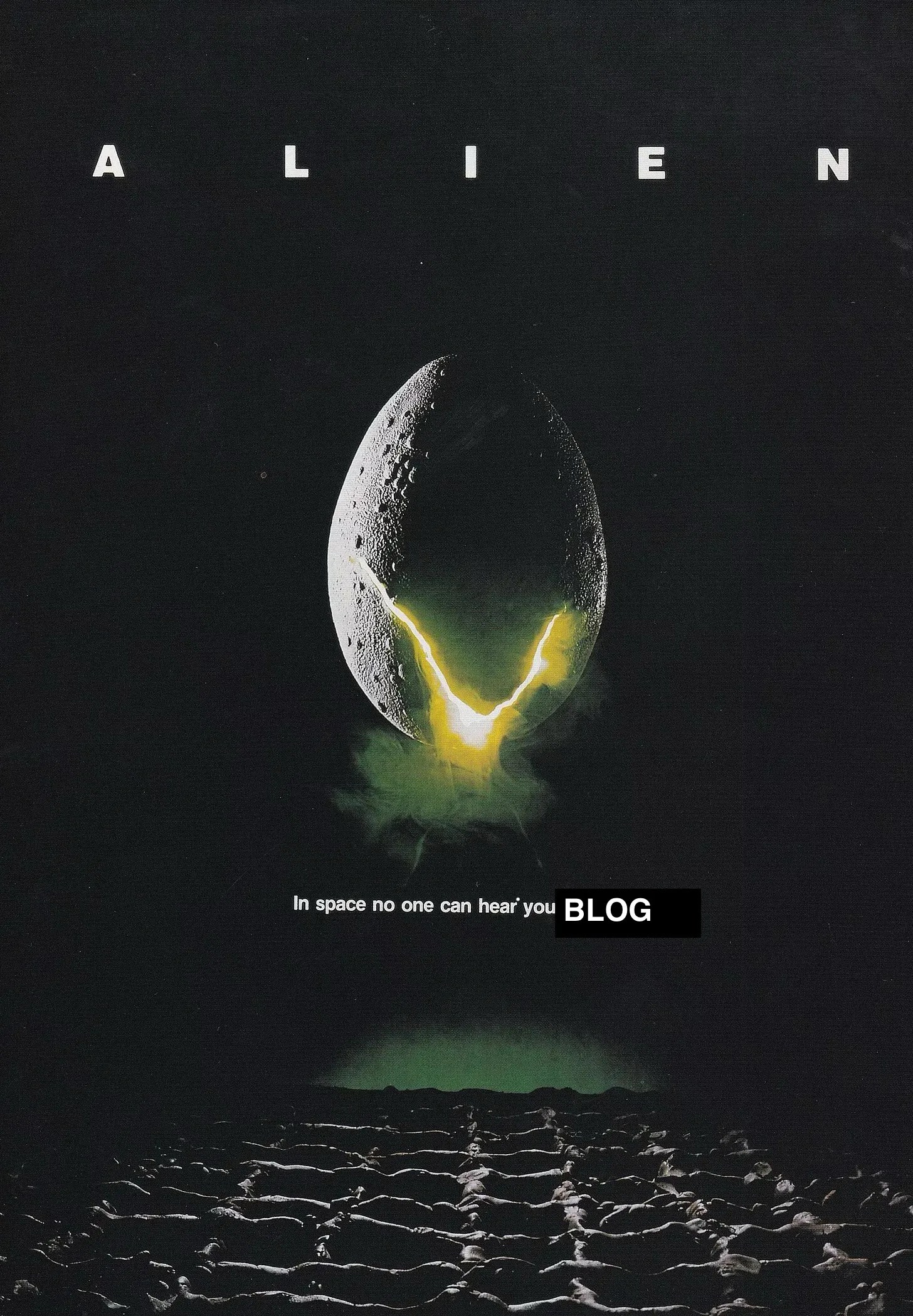
    I was eleven in 1979 when my dad took me to see Ridley Scott’s Alien at the Geneva Drive-In, in South San Francisco. I watched from the back seat of the car, peeking over the front seats and retreating to the safety of the footwell when things got too intense. I saw about half the movie, by which I mean about half of the screen at any given moment.

    46 years and endless sequels later, we forget how revolutionary the alien was as a cinema monster. The face hugger. The elongated head, ooze and dento-phallic jaws of the final form. It was a psychosexual nightmare rendered in latex and KY Jelly.

    Alien fucked up my head for years. Well into adulthood, if I was stressed out about something the alien would stalk my nightmares. At some point I started kicking its ass and it fucked off from my dreams, to be replaced by other stress proxies, like the nightmare I had last week where I couldn’t navigate Spotify. I preferred the monsters.

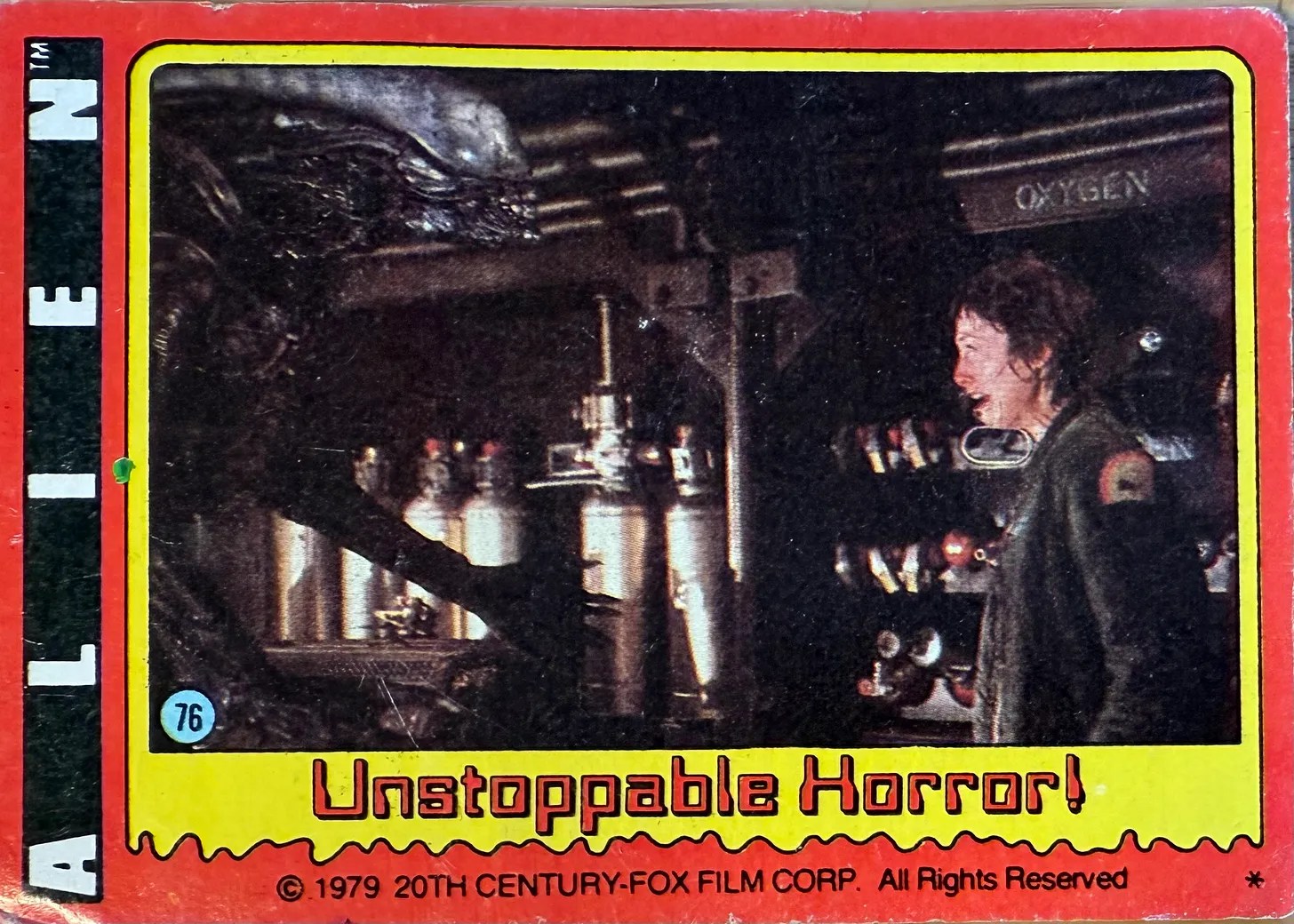
    Alien is my favorite movie of all time. I still have the complete set of trading cards, two copies of the Heavy Metal magazine comic adaptation of the movie, a vinyl of the original soundtrack, and the photo book of the film. Relics of me, age 11.

    Unstoppable Horror! (#76 in a series.)

    It is a truism that most science fiction is about the present, using fantasy and extrapolation to tell stories about contemporary society. Alien takes place on a spaceship, but it’s a 1970s labor movie from the cinematic era of Norma RaeBlue Collar and F.I.S.T. Seven schlubby, grease-stained astronauts fly a grimy, long-haul space tug while dealing with contractual issues and an employer so cold and remote that it is only referred as “the Company.”1 The first intelligible dialogue in the movie is the engineers bitching about their poor pay relative to the other, whiter-collared crew members.

    Read the rest on Substack

  • Triumph of the Wankers

    Triumph of the Wankers

    Stadium Concerts and the Iconography of Totalitarianism

    I am going to start with something polarizing. I like the band Oasis.

    When people who don’t like Oasis find out that you do like Oasis, they will often try an intervention, like they discovered you’re in a cult where everyone wears white Skechers and signs a suicide pact. People who are musically inclined will explain that your taste is basic, and start suggesting bands that use weird time signatures and exotic modes. If I wanted to listen to King Crimson, I would just listen to King Crimson.

    Plenty of Oasis’ music is simple. “Columbia” is A-D-C in a loop for five minutes. But AC/DC proved fifty years ago that there is a bottomless appetite for three-chord party rock, and I think it comes down to branding. Britpop produced a lot of interesting and thoughtful bands—Stone Roses, Suede, James, arguably Radiohead—and then there were Liam and Noel Gallagher, a two-headed wrecking-ball of surly Manchester sex-appeal.

    This branding divide was captured in the short-lived but intense Oasis vs. Blur Britpop rivalry of the mid-nineties:

    Blur:

    Oasis:

    Behold your revealed preferences.

    The Gallagher brothers famously despised each other and the band broke up in acrimony in 2009, years after their creative peak. But the shimmering aura of money has magical healing properties, like an amethyst chandelier, and the brothers embarked upon a reunion tour this year.

    My family and I lucked into tickets to the concert at the Rose Bowl in Pasadena last month. The Gallaghers could remember at any moment that they hate each other and tumble back into violence, so we couldn’t pass up the opportunity to see them together as it might never happen again. We had a great time.

    Read the rest on Substack

  • Imagethief Turns One

    Imagethief Turns One

    Looking back at hits and misses as we enter blog toddlerhood

    September 3rd was the first anniversary of this joint, so I thought I’d do a quick year-in-review. There will be a small amount of navel-gazing, but not too much. I write this blog for fun, and I presume you read it for the same reason.

    The Stats!

    Thanks to all 4651 of you who subscribe as of this writing! I am obviously not a threat to the Substack leaderboard, but I appreciate every subscriber and I still get a little thrill every time someone signs up. (I also want to walk into the ocean every time someone unsubscribes, which is just typical being-a-writer.)

    Some of you subscribe to 200 newsletters or more. This is not an exaggeration – I get the stats for each new subscriber. I am inbox-zero person and that would make me insane. I assume most of those are symbolic subscriptions, a sort of extra-vigorous “👍”, but I still appreciate it!

    Subscriber growth tends come in clumps when I drop a particularly successful post, or when Bill Bishop, my #1 cheerleader here and an old friend from our mutual days in China, gives me a boost. (Subscribe to Bill’s excellent Sinocism newsletter if you are at all interested in China or geopolitics!)

    Page views have trended steadily up, which is nice. The open rate is about 45%. I am inconsistent about promoting my posts on social media, but the best referring platform by far is (brace yourself) LinkedIn, followed by Bluesky, which is a recent artifact driven by some big-V reposts, and Facebook because I’m old. Everything else is rounding errors. I don’t post on Twitter anymore and only rarely on Threads. The one time I got good traffic from Threads is because I got into an argument with someone over my “Return to Commuterstan” post. The algorithm loves conflict.

    I’ve aimed for a post roughly every two weeks and I managed 29 over the first year, which was more or less on target what with an all-consuming job, kid, etc.

    Read the rest on Substack

  • Growing Popularity of Alien Brain Squids Fuels Controversy

    Growing Popularity of Alien Brain Squids Fuels Controversy

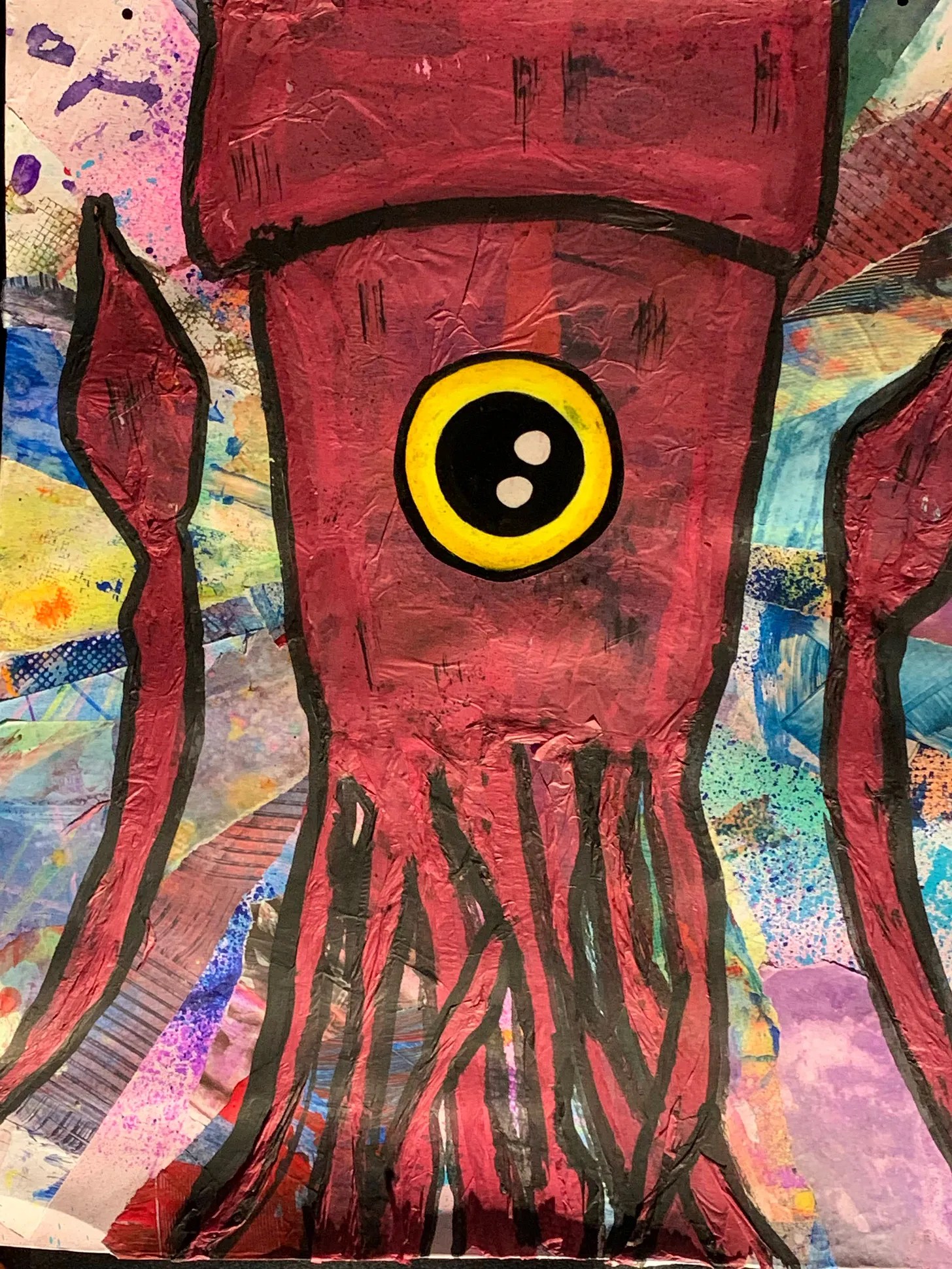
    Squid-wearers call for mankind’s extermination, but some say we should hear them out

    DES MOINES, Iowa—Aug 31, 2025—Debate raged today over the sudden popularity of head-worn squids in this normally sedate midwestern city.

    First noticed in social media posts from a handful of local residents demanding the immediate and unconditional surrender of humanity, the unconventional headwear has since become widespread. Students, professionals, and even the mayor have flaunted the oozing accessories.

    The appearance of the social posts and tentacular headgear was first reported in “Obvious Shit More People Should Be Talking About,” a newsletter written by Rachel Kaplan, a Des Moines-based independent journalist.

    At first confined to this historic agricultural capital, the trend has since spread to other cities in the region, with people in Cedar Rapids, Omaha and St. Louis sporting so-called “brain squids”.

    The new fashion is linked with an emerging set of beliefs based on the conquest of all human life and its subjugation to the demands of a mysterious authority figure sometimes referred to as “the supreme mollusk.”

    Read the rest on Substack

  • Red Packets in the USA!

    Evaluating a New York media scandal on the international beer metric

    Twenty years ago last March, I wrote my first blog post about PR in China. I had been living and blogging in China for nine months, but my early posts focused on daily life and had titles like, “I successfully speak Chinese to people,” and “I shop,” and so on. These are real titles, not jokes. I was delirious with culture shock.1

    When I finally wrote about work, I started with a post on a China PR practice that I found deeply weird. This was the “transportation claim,” the practice of giving every reporter who attended a press event an envelope of cash. Coming from obsessively Windexed Singapore, where I had started my PR career, this seemed sketchy. But my colleagues assured me that it was standard practice.

    In those days the going rate was 200RMB (then about US$25) for a Beijing print reporter who had come from in town. There were different rates for television crews and out-of-town reporters.

    Was giving a modest envelope of cash to a reporter who worked for state-owned media a violation of the U.S. Foreign Corrupt Practices Act? I didn’t know! But the leadership of the Beijing office of the big U.S. PR firm I worked at didn’t seem concerned, so, 🤷.

    I jokingly titled that old post, “A scholarly analysis of the economics of PR in China.” In it, I used beer, the PR pro’s favorite commodity, as a unit to assess the value of the transportation claim on a purchasing-power parity basis. In 2005 you could get a tall Yanjing or a pint of Beijing Asahi for RMB3 if you knew where to drink. Deducting the average cost of two typical Beijing taxi rides from the transportation claim, I calculated you’d have about RMB150 left over, or enough for up to fifty beers.

    In Singapore, which was my frame of reference, I calculated you’d need an envelope with a minimum of SGD$270 (about USD$180 at the time) to achieve the same thing.2 Hand a lot of those out and you would be at real risk of a sweaty afternoon in the basement of the Corrupt Practices Bureau.

    Read the rest on Substack

  • The Life and Death of a Cool Phone

    That time we tried to make the Moto X in the U.S.A.

    I’d been working for Burson-Marsteller in China for nearly six years when I got poached away by our client, Motorola. Jumping from agencies to clients can be tricky, but my boss at Burson gave me her blessings. Maybe she thought it would be good to have an alum as the client. Or maybe she was just happy to be rid of me and my obnoxious blog.

    This was 2010 and the iPhone was popular, but not yet the Greatest Consumer Product of All Time. Smartphones hadn’t changed the world, but you could feel the change coming and everyone wanted in on the action.

    I’d been smitten the first time I handled an iPhone, in 2008, and I’d bought a first-generation model shortly thereafter, on a work trip to San Diego. At the time, all iPhones were U.S. only and locked to AT&T. I had to jailbreak mine when I got it back to China so I could use it on China Mobile. This was terrifying, like performing brain surgery on your child with kitchen implements. I was sure I was going to lobotomize my new $600 superphone.1

    Amazingly, the patient lived. I promptly abandoned both my Motorola Razr V3 flip phone and my Burson-issued China Mobile Blackberry, which looked like a prop from the old Adam West “Batman” TV show. This lasted until I got a nastygram from Burson’s IT department scolding me for using an “unauthorized client.” Reluctantly, I shifted my work email back to the Bat-Berry. But I used the iPhone for everything else.

    No regrets! As small and slow as early models were, touchscreen smartphones were obviously going to revolutionize mobile computing and change our experience of the world. I’d known that the moment I saw the New York Times home page microscopically rendered on a 3 1/2 inch display, and again the first time I saw the map application tracking our location in real time while in a car. The only thing I regretted was losing the tactile snap! of slamming the Razr shut. Hanging up on someone would never be as satisfying again.

    I was in love with smartphones and when Motorola came calling, I was ready. Motorola was still a behemoth in 2010, but activist investor Carl Icahn was cleaving the company in two. Motorola Mobility, the new smartphone-focused business, had lured Sanjay Jha away from Qualcomm to be CEO. Jha was all-in on Android, and Motorola had launched the first Android smartphone in China, the lozenge-shaped XT800. I shelved my iPhone for an Android-powered handset, a goony Motorola Milestone with a slide-out keyboard. The future was wide open and the smartphone market was there for anyone to seize!

    In theory.

    Read the rest on Substack

  • The Kiss-Cam of Annihilation

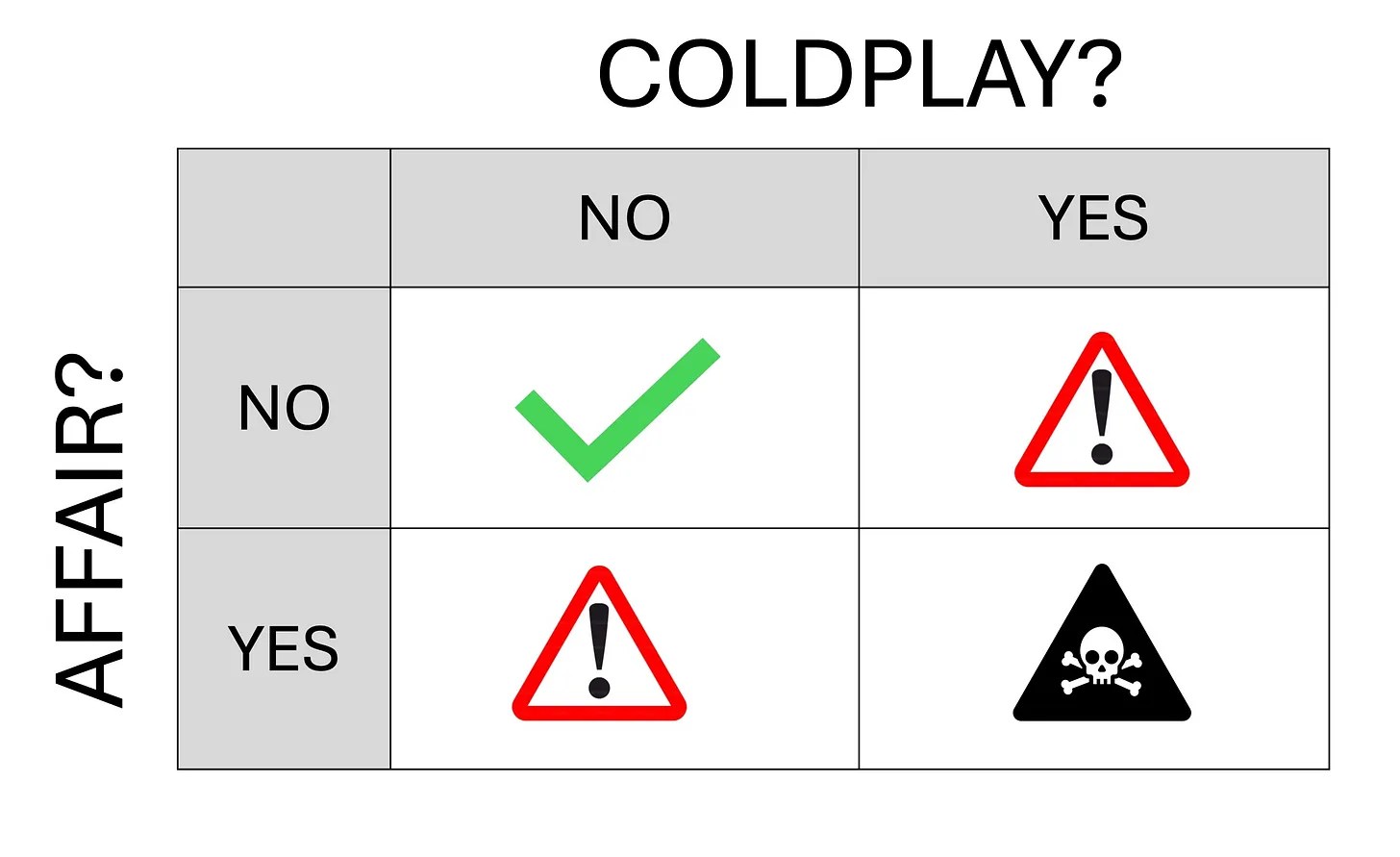
    The reputational risks of being a Coldplay fan

    Here is proof that the universe hates you:

    You go to a Coldplay show with your paramour thinking you will be safely anonymous in a darkened arena full of 50,000 people with similarly questionable music taste. Suddenly, like the eye of Sauron, the arena kiss-cam falls upon the two of you. Your canoodling mugs are now up there on the Jumbotron, illuminated and 10,000 times larger than life.

    If you’re at the concert with your date-who-is-definitely-not-your-spouse and with whom you have a professional relationship that absolutely precludes getting handsy at a Coldplay show, and the spotlight hits you, what is the move?

    Counterintuitively, the move is to kiss for the kiss cam, and maybe smile and wave. In short, do what you’re supposed to do in that situation, and, in so doing, be unremarkable so the camera moves on.

    The problem is that in this situation the human instinct to cower, hide and radiate high-energy shame particles is so lizard-brain reflexive, you’d have to be the genetic cross of Ethan Hunt and Mr. Spock to suppress it in the moment.

    Your lizard brain is telling you to subscribe to Imagethief!

    In this very real and not-theoretical situation, two people conspicuously did not suppress the instinct to cower and radiate shame particles. Instead, when the kiss-cam found them, they acted as guilty as a couple on a tryst could possibly act:

    View the video on TikTok

    It is physically impossible to act any more busted than that. The LeBron James of acting busted1 could not act more busted.

    Humans are social animals and naturally wired to recognize deep cringe. Coldplay singer Chris Martin and everyone else in the arena noticed this behavior. Within moments it was all over the Internet and the couple was promptly identified as the married CEO of software company Astronomer.io and his head of human resources who is definitively not his wife. It has since ascended into mainstream national media.2

    This is a crisis! A personal crisis. A corporate crisis. And definitely a music taste crisis. Let’s take them in order.

    Read the rest on Substack

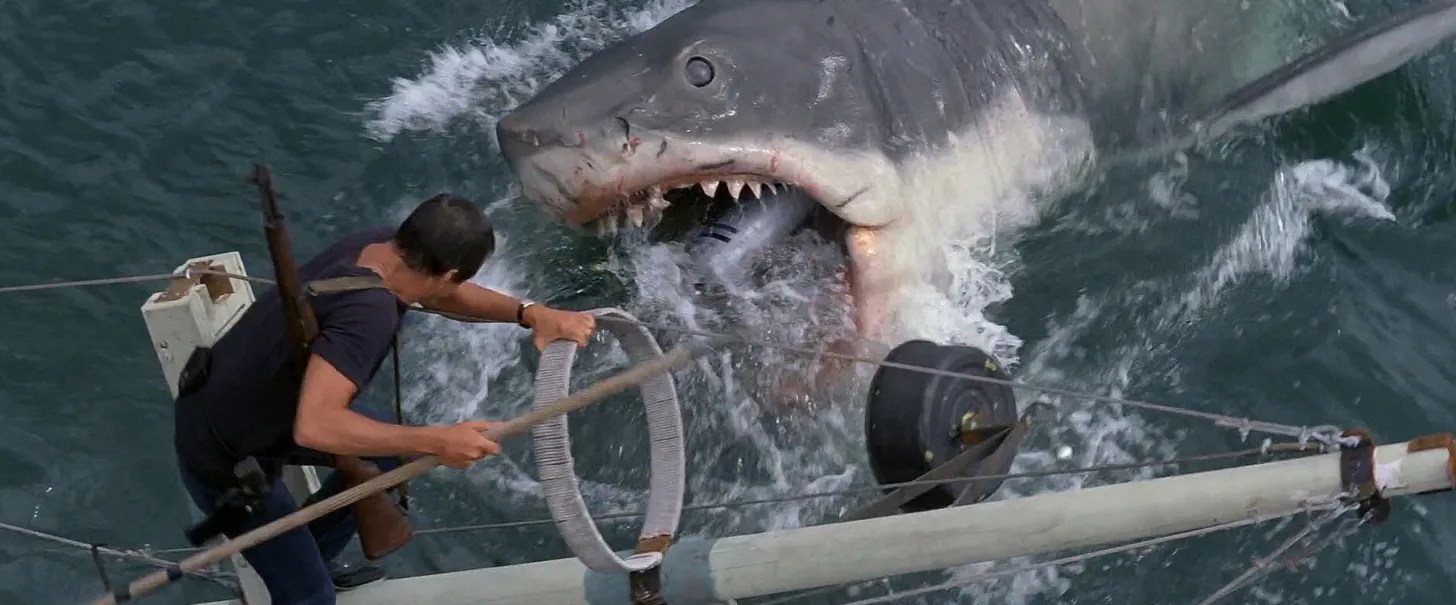
  • Who Speaks for the Killer Shark?

    You’re gonna need a bigger PR plan

    I saw Jaws for the first time when it premiered on network television. This was in in November 1979, just after I’d turned 12 and more than four years after the movie had been in theaters.

    In those days, if you wanted to see a movie after its theatrical run, tough shit. If you didn’t catch it in a second-run theater, you’d have to wait for one of the big-three networks to broadcast it. I didn’t know anyone who had a VCR or cable TV until I was in high school. Network premieres of hit movies were big events, hyped for months.

    I was living with my dad in the top two floors of his ramshackle four-story Victorian in San Francisco’s Castro neighborhood. He was a relaxed parent, and not hung up on the child-appropriateness of media. Earlier that year he’d taken me and my younger brother to see Ridley Scott’s Alien at the Geneva Drive-In, in Daly City. That movie fucked my head for years. I still love it.

    Jaws was ABC’s Movie of the Week, at 8:30PM on a Sunday night. I remember watching the first part in the living room with my dad. He’d recently upgraded his old black-and-white TV to a larger color set, a revelatory change.

    About halfway through the movie, my dad sent me to bed. Maybe he thought it was getting too gruesome, but it was also a school night. Fair enough.

    Old, serially remodeled Victorians have lots of eccentricities. In my dad’s house, one such eccentricity was a star-shaped cutout in one of the risers of the steep staircase up to the attic, where the bedrooms were. It was only four or five inches across, but it had oblique line-of-sight through the downstairs hallway, into the living room and to our new television. I watched the entire second half of the movie crouched on the stairs, eye glued to the star-shaped cutout.

    Read the rest on Substack

  • Good PR People Don’t Lie

    Also, a dumb theory of lying in PR

    I stumbled into a PR career ass-backward. I say this with love and respect for those of you who dreamed of a PR career, went to PR school and diligently worked your way up. But that’s not how it happened for me.

    It was late 2001 and startup number two in Singapore had imploded following the collapse of the dot-com bubble and some poor management choices. Italian furniture isn’t cheap. Six years and two dead startups into my Singapore journey, it seemed like time for a change of vocation. Also, no one was hiring “Internet” people in 2001. Sitting in the oily puddle at the the bottom of the trough of disillusionment, we were best not touched with bare hands, like medical waste.

    Some of my beach football friends worked for the Singapore office of a small New Zealand-based PR firm. They had a problem in the form of Microsoft Singapore, one of their clients. Nobody at the agency knew much about technology, and the notoriously demanding Microsoft team was losing patience.

    On the beach, a ropey and affable New Zealander, who was amazingly fit and fast at the inconceivably geriatric age of 45, made the pitch. I had worked in radio and television in San Francisco and co-written two books about computer games, and I had just done several years of technology project management and had a good grasp of Microsoft’s products. Had I ever considered working in public relations?

    I had not. Not only that, but at startup number two I’d held our PR woman in cold contempt. I didn’t understand her job. Her requests seemed burdensome and trivial. I had important things to do!

    Karma is, as they say, a bitch. I owe her the hugest apology.

    I owe you an apology for this newsletter. But you should still subscribe.Subscribed

    I met the agency’s Singapore office leader, Kylie, a radiantly charismatic Australian woman who was the team rainmaker. “Ehhh,” she drawled when I pointed out that I had zero PR experience. “You can write and you understand tech. We can teach you the PR bit.” Also, she offered double what anyone would pay me to do Internet related work.

    I negotiated the final details of the job a week or two later, while in Laos with my father, standing ankle-deep in the Mekong in Vientiane so I could catch a Thai cell signal from across the river. And that is how, at the age of 34, I made a mid-career switch into comms. And probably also got some kind of hideous river-borne blood parasite.

    Read the rest on Substack

    Don’t be a serpent.

  • Pitchwrap Supreme

    The art of getting your stoner snack into the New York Times

    The last time I remember being in a Taco Bell was in the late eighties, when I was a student at U.C. Santa Cruz. My buddy Darren and I had just completed a round of epic late-night bong rips at an off-campus house and the munchies had arrived as inevitably as the tide. The Taco Bell on Mission Street, around the corner, was open until the wee hours. As we waited in line, Darren slowly read the menu out loud:

    “Nachos.

    Nachos Bel Grande.

    Burrito.

    Burrito Supreme.

    Burrito Supreme…with hair.”

    I don’t remember if we actually ordered anything. Or, if we did, what it was. But it says something that the image of a Burrito Supreme with hair has been stuck in my head since 1989.

    A lot of my college experience lay at the intersection of my friendship with Darren, our youthful love of the herb, and snacks. There was the time we dried some leaves from the plant in Darren’s room in an electric kettle (not recommended!), smoked it all and then bought every cookie in Sluggo’s, the dorm coffee shop. After dividing the cookies, we slunk back to our respective dorm rooms to devour our prey in solitude, like stoned leopards.

    Read the rest on Substack

    For your munchies…

Thank you for subscribing!

Please check your email to confirming your subscription.