• U R fired thx

    U R fired thx

    Fox News’ statement about Maria Bartiromo said a lot by saying very little

    September 7th, 2026

    Happy Labor Day, American readers! Let’s celebrate by talking about firings.

    Last week news broke that long-time Fox News personality Maria Bartiromo was leaving the broadcaster. This came just a couple of days after White House press secretary Karoline Leavitt stepped down. Immediately, people started speculating on social media that Bartiromo was leaving Fox to take the podium in the White House press room.

    I don’t normally preoccupy myself with the professional fates of Fox News personalities. I don’t watch broadcast news unless I have to for work reasons or the shit is really going down somewhere. I don’t have cable, and endless panels of talking heads chortling at each other makes me want to die.1 Also, to put it politely, Fox News is not compatible with my politics. But the press secretary rumor was interesting, so I went and looked at Fox News’ statement:

    “We thank Maria for her work over the last 12 ½ years and wish her all the best on her next chapter.”

    I thought, this woman is not taking the press secretary gig. She has been fired.

    Here is the whole Fox News press release, minus the boilerplate at the end. I’ve highlighted the portion of the release that is about Ms. Bartiromo. Everything else is programming details:

    FOX NEWS PARTS WAYS WITH MARIA BARTIROMO

    NEW YORK – September 3, 2026 — Effective today, Maria Bartiromo is no longer with FOX News Media.

    In making the announcement, FOX News Media said, “We thank Maria for her work over the last 12 ½ years and wish her all the best on her next chapter.”

    The last episode of Mornings with Maria (6-9 AM/ET) aired this morning on FOX Business Network (FBN) and the show will transition to Mornings with FOX Business beginning tomorrow with rotating anchors. Maria Bartiromo’s Wall Street which also airs weekly on FBN (Fridays, 7-7:30 PM/ET) will shift to FBN’s Wall Street effective this week hosted by Cheryl Casone and helmed by rotating anchors thereafter. FBN will also launch a new weekday programming schedule which will be announced in the coming weeks.

    Additionally, FOX News Channel’s (FNC) Sunday Morning Futures (10-11 AM/ET) will be hosted by Jason Chaffetz this Sunday and a new host will be announced at a later date.

    That is the corporate version of kthxbye and moons-of-Jupiter cold for a twelve-year tenure.

    A statement doesn’t have to be long to set a tone, and there are recent examples of Fox News on-air personalities leaving for administration roles. They are vastly warmer than the Bartiromo statement:

    For Pete Hegseth:

    “Pete Hegseth has been an exceptional host on ‘FOX & Friends’ and FOX Nation and a bestselling author for FOX News Books for nearly a decade. His insights and analysis, especially about the military, resonated deeply with our viewers and made the program the major success that it is today. We are extremely proud of his work at FOX News and wish him the best of luck in Washington.”

    For Jeanine Pirro:

    “Jeanine Pirro has been a wonderful addition to The Five over the last three years and a longtime beloved host across FOX News Media who contributed greatly to our success throughout her 14-year tenure. We wish her all the best in her new role in Washington.”

    And for Neal Cavuto, who didn’t leave for an administration role, but did leave after a long tenure:

    “Neil Cavuto’s illustrious career has been a master class in journalism and we’re extremely proud of his incredible 28-year run with Fox News Media. His programs have defined business news and set the standard for the entire industry. We wish him a heartfelt farewell and all the best on his next chapter.”

    “Exceptional!” “Wonderful!” “Illustrious!” Words not appearing in the Bartiromo statement. But you know who did get a statement a lot like Bartiromo? Tucker Carlson:

    FOX News Media and Tucker Carlson have agreed to part ways. We thank him for his service to the network as a host and prior to that as a contributor. Mr. Carlson’s last program was Friday April 21stFox News Tonight will air live at 8 PM/ET starting this evening as an interim show helmed by rotating FOX News personalities until a new host is named.”

    Again, the highlighted part is about Carlson, and the rest is programming details. I wonder what Bartiromo and Carlson have in common? (We’ll get to it.)

    A portrait of Maria Bartiromo with a neutral expression. She is wearing glasses, a blue pinstripe blazer and a double string of pearls, and at a three-quarter angle to the camera, looking left. The background is a blurry, pastel blue.
    Literally cancelled.

    I have written and shipped lots of executive departure statements over the years. In general, assuming the executive is prominent enough to require a departure statement at all, there is a relationship between circumstances and word count. The better the circumstances of the departure, the longer and more fulsome the statement. The worse the circumstances, the shorter.

    The exception to this rule is when a departure is so acrimonious or material that the company needs to preemptively publish a bunch of receipts on the way out. The curve looks something like this:

    A graph showing the relationship between word count and circumstances, with a smiley face at high word count indicating good outcomes, a skull at low word count indicating bad outcomes, and a woman’s photo in the middle representing a neutral point.
    Fig. 1: The shit-fan – wordcount curve.

    On the far left of the curve is a typical feel-good departure. A respected senior executive retiring after a successful run, or leaving to take on a prestigious role at an organization that doesn’t compete with the prior employer. Look at Wal-Mart’s announcement of Doug McMillon’s retirement and succession by John Furner. 631 words, a quote from McMillon, a laudatory quote from the chairman of the board, not to mention some buddy photos of McMillon and Furner together. A variation on this is giving a departing executive space to publish their own communication, as Tim Cook did last week, when he handed over the Apple CEO role. Or, since I mentioned it above, look at the White House’s laudatory statement about Karoline Leavitt.

    On the far right of the curve, things are bad and risk is high. The company has had to fire an executive in a situation so scandalous or material (say, removing a CEO) that broader messaging is required. Often in these situations the departing executive still gets brief treatment, and most of the text is dedicated to the path forward and the qualifications of the replacement. Some examples are Tony Hayward’s departure from BP in the wake of the Macondo oil well disaster, Laurent Friexe’s departure from Nestlé for ethical lapses and Brian Krzanich’s departure from Intel (which I worked on) for similar lapses. In all of these examples there is brief paragraph on the departing exec, and most of the text is devoted to the qualifications of the incoming exec, remedial actions and statements of principle.

    In very bottom of the curve is what happened to Maria Bartiromo. She was visible enough that her departure needed to be acknowledged. And…that is all. No praise. For an on-air celebrity with twelve years of tenure, that told me the circumstances were bad. It’s not material, and there aren’t operational concerns, so you don’t need a bunch of continuity and safe-hands messaging to soothe customers and investors. Just, so long and don’t let the door hit you on the way out.

    This is all a giant oversimplification. Many factors can influence an executive departure statement. There might be litigation risk to account for. The details of an exit statement might be negotiated as part of a separation, a thing I’ve dealt with a few times in cooperation with HR and legal teams. A corporate officer’s departure will require an SEC filing. Sometimes you’ll ship a departure statement proactively, sometimes you’ll hold it in reserve and hope no one notices, though this doesn’t work with highly visible execs—or on-air talent—whose absence will be noticed. In a potentially acrimonious departure, we might prepare all sorts of stuff, but keep it in reserve in case we have to go to war. But the word count curve is a reasonable rule of thumb.

    Speaking of litigation risk…

    Why the unceremonious departure and minimalist statement for Ms. Bartiromo? It took a day or two to emerge, but the story was colorful. From the New York Times:2

    In July, as President Trump was preparing a prime-time speech on election security, word went out from executives at Fox News: The network would avoid covering his stock claims about a stolen election.

    Fox had landed in serious legal trouble in 2021 after amplifying false assertions by Mr. Trump’s allies about vote-stealing election machines, culminating in an extraordinary $787 million defamation settlement.

    In 2020, Fox Business host Maria Bartiromo had made her show a central stop for proponents of the president’s election theories. And this summer, too, she was preparing to interview the presidential adviser Peter Navarro the morning after the speech.

    But after she received a text message written by a Fox Business executive warning against post-speech coverage, she canceled Mr. Navarro’s appearance.

    As she did so, she shared the executive’s text with Mr. Navarro, who promptly sent it “up the chain” to the White House, he said in an interview Friday. It was his duty, he said, to relay “yet another example of Fox personnel censoring the Trump administration.”

    It appears that Ms. Bartiromo faced a test of whether her loyalty lay with her employer or the administration, and she chose the administration, forwarding an internal communication to the White House. This violated confidentiality and created immediate blowback for Fox News, which had already eaten a huge settlement on the issue of unsubstantiated election fraud allegations.

    That’s bad! Your employer can no longer trust you! You will be fired! The statement announcing your departure will be terse and sound like it is coming through clenched teeth!

    The defamation settlement was with Dominion Voting Systems, after Fox News accused the company of involvement with voter fraud. Tucker Carlson also left in the wake of the Dominion settlement, apparently because the legal discovery process disclosed embarrassing emails he had sent, many criticizing his Fox colleagues and the Trump administration. He was also being sued by a former producer over alleged sex discrimination. He was Fox’s most popular host, but he had become a liability. Corporations are cold that way.

    In neither Ms. Bartiromo’s nor Mr. Carlson’s case did Fox News say they were “fired.” Instead, the company used the conveniently vague formulation, “parted ways.” Bartiromo has lawyered up and her counsel said this to Variety on Friday:

    “The irresponsible reports that have been published stating that Maria Bartiromo was fired or is no longer an employee of Fox are absolutely and unequivocally false. Make no mistake, we have the receipts and witnesses and they will come out whether through the courthouse or otherwise. Those reporting her firing or the incredulous facts supporting that fiction have exhibited a complete and utter reckless disregard for the truth. “

    I don’t know, man. “Parted ways,” may be vague, but it’s not that vague. The lawyer’s statement may be angling to get Bartiromo released from her Fox News contract, which the New York Times says is still in force, so she can seek work elsewhere. But by all means, bring forth the receipts and witnesses. The assembled media reporters of New York will enjoy every minute of it. Also, not the biggest thing, but wrong use of “incredulous.”

    I expect that Bartiromo is done at Fox. But One America News and Real America’s Voice are surely on the hunt for big-name MAGA talent. And there’s always the Tucker Carlson self-branded YouTube approach. Or, god help her, a newsletter.

    Meanwhile, “Mornings with Maria” is done and Fox News needs a new host for their morning slot. Not to start any rumors, but I hear Karoline Leavitt is available and her last employer thought very highly of her.

    1. I actually started my media career in local broadcast news, back in 1991, as an intern and later part-timer at KPIX TV News in San Francisco. They were a CBS affiliate and the key talent were Dave McElhatton and Kate Kelly. Gen-X San Franciscans may remember them. I worked the assignment desk on weekends, which was quite a bit of fun. TV newsrooms are exciting places. I left to move into radio because I hate myself. One of my outstanding memories of my time at PIX (as we called it) was the big cardboard box of little packets of pain pills bolted to one of the hallway walls. Over my year and a half tenure the level of packets ebbed and flowed like the tides, in sync with big news moments. ↩︎
    2. Oliver Darcy’s media-watching newsletter Status  actually broke the behind-the-scenes story, but I am guessing more people will be able to view the NY Times’ article. But you should subscribe to Status. ↩︎

  • How to Lose a War With the Press

    If you’re going to burn, at least burn for doing the right thing.

    At heart, PR is a simple trade. Figure out interesting stories and tell them. Build trust with reporters and others in positions of influence. Try to not screw up egregiously. There is craft and skill implied in those three points, but that’s the gist of it.

    Nevertheless, people continue to find ways to screw up egregiously. If your PR strategy ends with you and your former employer paying $57 million dollars in legal settlements, you have screwed up.

    A couple of weeks ago, e-commerce site Ebay settled a lawsuit with David and Ina Steiner, editors of EcommerceBytes, a trade news website, concluding a case that dates back to 2019. In 2020 the New York Times published a long a deeply reported piece on the scandal, and it’s worth a read if you want all the grisly details. If you don’t have that kind of time, a July 28th Times story on the settlement has a summary:

    In the spring of 2019, eBay was under pressure from an activist hedge fund. A handful of Ms. Steiner’s articles, including one about a bar [then Ebay CEO Devin Wenig] had built on eBay’s campus, infuriated company executives, according to texts revealed by prosecutors. Further details of the stalking operation were later revealed by journalists and the Steiners’ own lawsuit, which was filed in 2021.

    “Take her down,” Mr. Wenig told his communications chief, who in turn told the security team leader to do “whatever it takes.”

    The Steiners were bombarded with anonymous material including deliveries of live cockroaches and a bloody pig mask. They were threatened online. Much of the material they were sent, including a funeral wreath and a book on surviving the loss of a spouse, suggested imminent death. The security team was on the verge of breaking into the Steiners’ garage to put a tracker on their car when the plot was derailed.

    No! Wrong! Bad! If you are a communications chief and you get a request like this, you have two options:

    1. Counsel your executive on why this is a bad idea and offer alternatives.
    2. Resign on principle.

    You may have to do both of these things, in this order!

    Read the rest on Substack

    A sepia-toned scientific illustration of a coiled rattlesnake, labeled "Fig. 148 - Rattlesnake"
    Don’t be a snake!

  • The Big Move

    The Big Move

    Emptying the nest all the way out

    When I cradled my newborn son, Zachary, in a daze in Beijing in 2008, the idea of him as a young man seemed as remote as the planet Neptune. Babies are all-consuming in their baby-ness and it’s hard to imagine someone as an adult when they’re the size of a pineapple, can’t hold their own head up and merrily shit themselves. There is so much growing-up to come! Jesus, when he’s eighteen I’ll be…well, best to not think about that.

    A thing about time is that if you wait long enough, even the remotest of deadlines will eventually arrive. Zach turned eighteen in March, which makes me…well, still best to not think about that. He graduated from high school two weeks ago and I am all the things you’d expect: proud, a little sad, mystified at how the years of his childhood seem to have compressed into a heartbeat. Relieved that I don’t have to change diapers at 2AM anymore.

    Despite mostly growing up in California, Zach is obligated to return to Singapore for 22 months of national service starting this August. When he was born, my wife and I didn’t know whether we would return to Singapore, where she is from, or to the US. We hedged our bets and got him both passports. The Singapore passport was hand-delivered to our apartment by two young embassy staffers along with a national service obligation and, to cushion the blow, a delightful gift basket. A reasonable trade, I thought, as I ate the butter cookies in the basket. Somebody had to eat them, and Zach didn’t have any teeth yet.

    Friends have asked me over the years if I couldn’t get Zach out of national service, but this misunderstands my feelings. I am fully NS-pilled and excited for him to do it! This is easy for me to say since I’m definitely not the one doing it. But, in hindsight, a couple of years of discipline before I showed up for university would have done me good. I sacrificed my freshman year on the altar of monster bong rips and two-liter Sapporo mini-kegs before my parents gave me The Talk.

    Fortunately, Zach is a better student than I was and has no discernible interest in monster bong rips, which are frowned upon in Singapore, or Sapporo mini-kegs, which start good but finish flat, warm and pungent, like a road-killed tanuki in a Hokkaido summer. He’s grown up knowing that NS was coming and seems to accept it as the price of being half-Singaporean.

    My wife and I have always planned to return to Asia while Zach is in NS. For a long time this was a distantly appealing prospect that we chatted about with other parents at playdates full of six year olds. It was a thing that would happen, you know, someday, like AARP membership or a prescription for statins.

    Well, motherfucker, someday is here and now we have to move back across the Pacific. I also get regular AARP membership pitches in the mail, which makes me…honestly, best not to think about that.

    Read the rest on Substack

    Hey, kid, easy on those throttles.

  • Black or White

    Black or White

    How hard should we cancel the Michael Jackson biopic?

    I was in high school in 1982 when Michael Jackson’s Thriller came out. Those were the days of national monoculture, and that album was the aural equivalent of chewing gum on your shoe. It was in cars, in malls, in the 7-11 while you were getting a Slurpee, just impossible to ignore. People forget that “Michael or Prince?” was a national debate during Reagan’s first term.

    The videos for “Beat It,” “Billie Jean” and “Thriller” were credited with breaking the “color barrier” on MTV, which was barely a year old and a new taste-making force in pop music. Seven of the nine tracks on Thriller were top-ten hits and the album was number one on the Billboard charts for 37 weeks. Michael Jackson, 24 years old but nearly two decades into his pop-music career, reached celebrity escape-velocity and became the King of Pop™.

    Jackson’s life story is fascinating. Molded into early celebrity by a domineering father, he appeared to spend much of his life in arrested childhood. Neverland Ranch, Bubbles the chimp, his extreme cosmetic surgery and progressive de-blackification, his masked kids. A troubled late-career shadowed by debt, drug abuse, deep eccentricity and several credible allegations of child sexual abuse, most famously covered in the 2019 documentary Leaving Neverland.1 Finally, death at 50 from a drug overdose on the eve of a series of comeback concerts in London. Fertile territory for a biopic on race, celebrity, sexual pathology and the cost of fame! 

    Alas, that is not the biopic you’re going to get. The biopic you’re going to get is Michael, and it is reportedly on track to be a monster hit. But the movie elides all that late-career complexity and ends with Jackson’s triumphant concert at Wembley in 1988, when he was still on the rise and before any troubling child sexual abuse allegations.

    Read the rest on Substack

    From the producers of “Bohemian Rhapsody”
  • French Harder!

    French Harder!

    An air crash, the politics of language and the dangers of unresolved tension

    Let’s say you’re the CEO of a national air carrier. It’s a big job that comes with lots of pressure! One of your aircraft is involved in a runway crash that results in the tragic deaths of two pilots and injuries to a number of passengers. All the early indications are that your airline is not at fault. But, as CEO, it is your responsibility to communicate sentiment on behalf of the company, and to explain the actions the company is taking.

    You record a four minute video in which you offer condolences for deaths of the pilots and explain what you are doing to support the passengers and other crew members. You are appropriately solemn. You say all the right things, considering the circumstances. Job done, right?

    Maybe not…

    Carney slams Air Canada CEO for English-only remarks after crash reut.rs/47l7vdr

    Reuters (@reuters.com) 2026-03-25T19:45:10Z

    It is a public relations truism that poor communication can make a crisis worse. Typically, that means things like responding too late, getting demonstrably ahead of the facts, omitting or obfuscating important information, or releasing inconsistent or muddled messages.

    Or, one might be “tone deaf,” meaning your remarks sound poorly calibrated to the gravity of the situation or the feelings of stakeholders. A canonical example of tone deafness is a remark by Tony Hayward, CEO of BP during the Deepwater Horizon explosion and oil spill. In the midst of apologizing for the situation on TV during what was supposed to be a shirtsleeves “we’re fixing it!” PR hit, he said, “There’s no one who wants this thing over more than I do. I’d love my life back.” This was after 11 people died on the rig and the gulf coast fishing industry was wiped out.

    Three days later, he was apologizing for his apology. Always a bad sign! A few weeks later, he was out.1 The statement wasn’t the only reason but it sure didn’t go in the board’s “keep him” column. Here is advice: live your life so you are never used as a case study of crisis comms gone terribly wrong!

    Read the rest on Substack

    Not the actual crisis!
  • The Predictable Prediction Crisis

    The Predictable Prediction Crisis

    The risks of being able to bet on anything, anytime

    One of the things that makes a good crisis comms person is being able to imagine bad situations. The benefit is that you can envision possible scenarios and plan accordingly. The drawback is that you will be a downer at office holiday parties.

    Everyone: Merry Christmas!

    Me [scrolling Bluesky]: Hey, have you seen how many people get violently sick from bad eggnog?

    Everyone:…

    Me: Noël! [Dumps eggnog back into punchbowl]

    If you’re going to prepare for crisis communication, you need to be able to have frank discussions about the possible crises. Death. Crime. Disasters. Whatever. Does it seem silly to prepare for a global pandemic that shuts everything down for a while? Guess what!

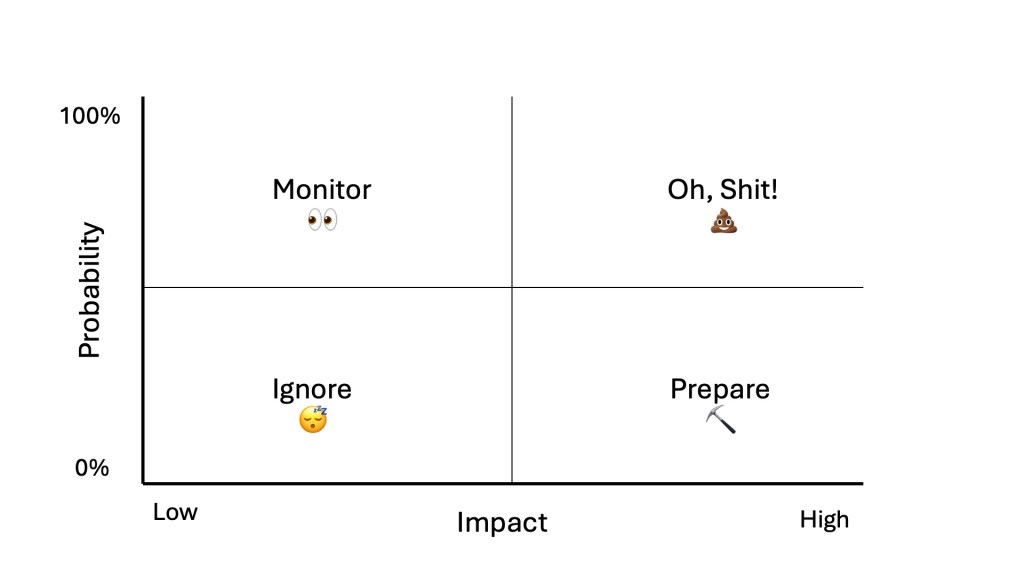
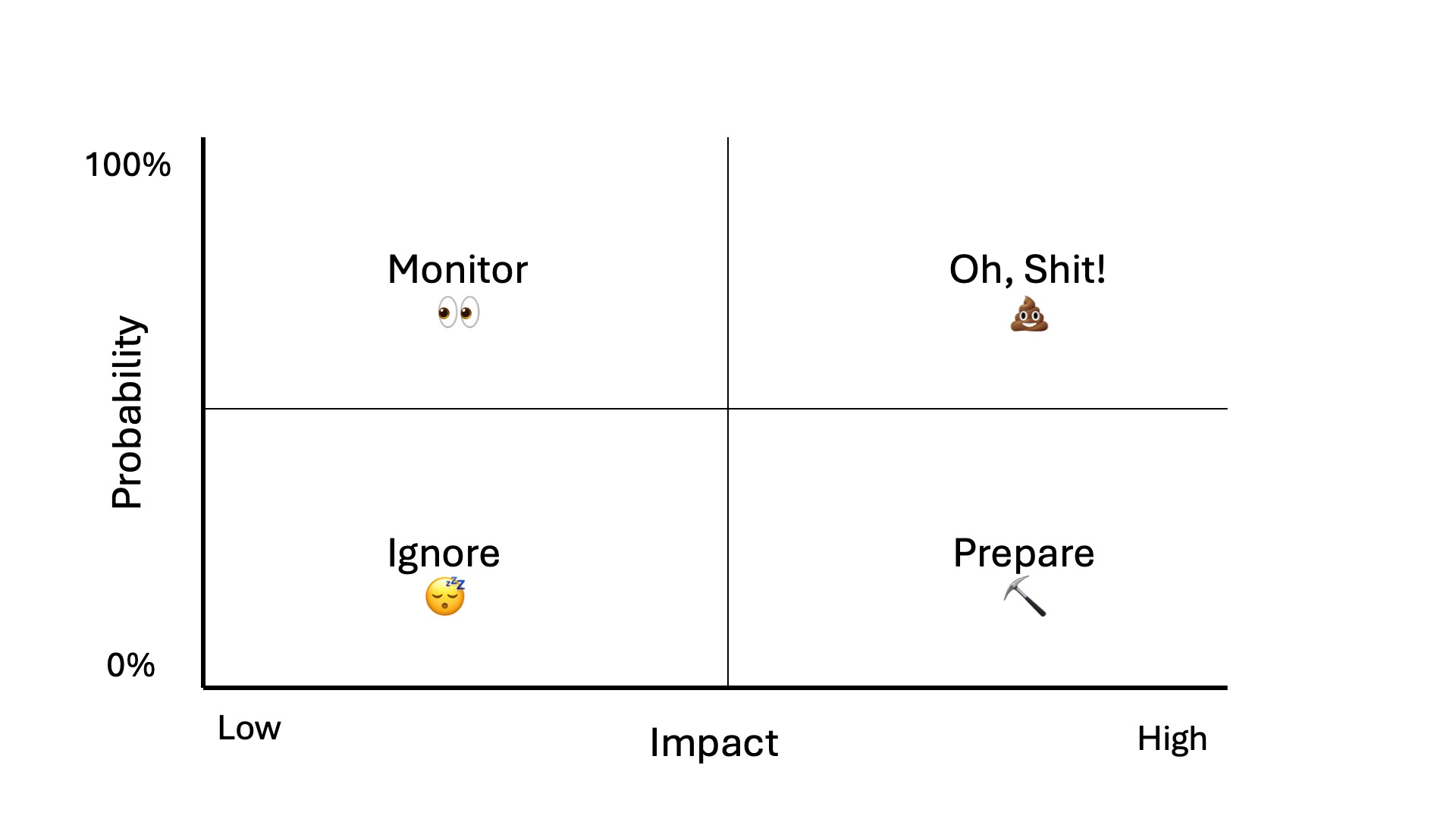
    There is an infinite number of bad scenarios, you can’t prepare for everything, and not all risks demand the same degree of preparation. There is a simple matrix that comms people (and our friends in risk management) sometimes use to think through which scenarios we should be spending time on:

    Obviously, this is oversimplified. “Probability” is timeline dependent and “impact” is contingent on various assumptions. You’re not so much plotting points as little clouds. People will argue about where in the matrix to place things. Sometimes they’ll argue for motivated reasons, like protecting a revenue stream. That’s another risk!

    But it’s a useful heuristic. Alien invasion? High impact! Vanishingly small probability. Don’t worry about it. If it happens, no one will blame you for not having a comms plan and your boss will be too busy fleeing to his luxury bunker in Big Sur with a suitcase full of ketamine to give you a hard time.

    The landscape is always changing and risk maps are dynamic. Two years ago, tariffs weren’t a major consideration. Today they are. What fun! We’re always assessing new risks, or considering what might be causing current risks to shift their position on the matrix.

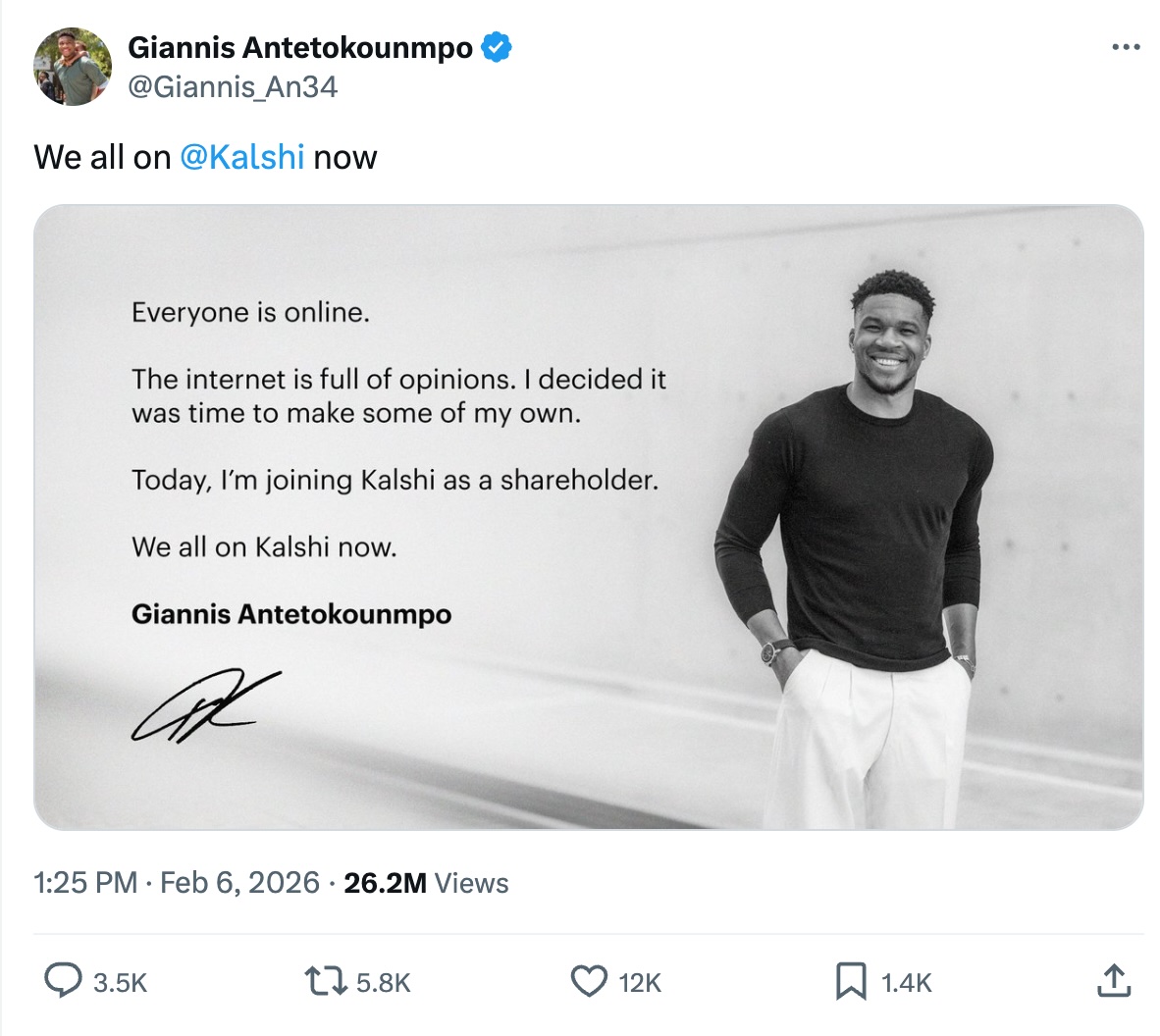
    Often, you’re just tweaking the map. This or that risk becomes incrementally more likely or potentially more damaging, so you move the plot a few pixels. But occasionally something novel sprouts on the map like a poisonous mushroom. The thing that made me realize there is a shift in the risk landscape was this tweet from NBA star Giannis Antetokounpo, a few weeks ago:

    We not all on Kalshi, Giannis!

    Giannis’ investment prompted reasonable questions, but maybe it will be fine! When has the collision of sports and gambling ever been a problem? And between the two main prediction markets, Kalshi is the sober option, as amazing as that is.

    But a current star player becoming an investor in a lightly regulated prediction market app seems like hurdling the Rubicon and landing in brand new risk territory much broader than sports. Since that tweet, things have got weirder as the prediction markets have been implicated in several “insider trading” events and novel controversies:

    • An anonymous account on Polymarket made suspiciously timed trades on the capture of Nicolas Maduro in Venezuela that netted more than $400,000.
    • OpenAI fired an employee for trading on confidential information on Polymarket.
    • Kalshi banned and fined an editor for mega-YouTuber Jimmy “Mr. Beast” Donaldson for betting on planned stunts he had knowledge of and a California gubernatorial candidate for betting on his own candidacy.
    • Mystery bettors on Polymarket seemed to have the inside track on the start of American bombing in Iran. $529 million was wagered in total and six suspiciously new accounts cleared a million each with uncanny knowledge of the timing.
    • Two Israeli reservists were arrested for using classified information to place bets on Polymarket.

    Listed companies have always had insider trading risk. But the domains of insider knowledge that mattered were relatively constrained: financial results, major transactions, other material corporate developments. Such information is also often restricted to specific teams or departments. Venues for trading on that knowledge were also limited and tightly regulated, at least in the U.S.

    Read the rest on Substack

  • The People v. McRib

    The People v. McRib

    The press bites on a sandwich lawsuit

    Here’s a possibly controversial theory: Lawyers are just specialized PR people.

    I can hear my lawyer friends clenching their jaws, but hear me out. Contracts are communication. Courtrooms and arbitration hearings are communication. Demand letters are communication. And class action lawsuits are definitely communication, often written both to advance a legal argument and to generate press attention.

    Here’s a fun example: “Le, Lynch, Baker and Wilson v. McDonalds Corporation.” The complaint is entertaining, and the first two paragraphs set things up better than any summary I could write:

    1. “The McRib is back!” is a phrase recognized across the United States, stirring excitement among McDonald’s customers eager for the limited-time sandwich offering. For decades, McDonald’s has cultivated a sense of anticipation around the McRib, leveraging its scarcity to drive sales across its many locations. Fans eagerly await each return, trusting that the sandwich they’re biting into is exactly what the name implies: a sandwich crafted using pork “rib” meat, which is prized by consumers for its high fat content and rich flavor.
    2. The reality, however, is far from what McDonald’s advertising and branding suggest. Despite its name and distinctive shape—its meat patty has been deliberately crafted to resemble a rack of pork ribs—the McRib does not contain any actual pork rib meat at all.

    The italics are in the original, just to make sure you get it.

    If the McRib isn’t rib meat, what is it? I’m glad you asked, and so are the lawyers who filed the suit!

    Instead, [the McRib’s] meat patty is reconstructed using ground-up portions of lower-grade pork products such as, interalia, pork shoulder, heart, tripe, and scalded stomach.

    “You sold people a sandwich marketed as a ‘McRib’ that contained no rib meat” isn’t Love Canal-level on the harm-o-meter, so the gross-out line is there as a lure for the press and social media posters. Did it work? You bet it did! Here’s the New York Post:

    The primary ingredient of the sandwich, which has found a cult following thanks in part to its on-again, off-again status on McDonald’s menu, is restructured pork composed of parts like shoulder, heart, tripe and scalded stomach, the complaint alleges.

    The alleged ingredients also get repeated by CBS ChicagoNBC ChicagoUSA TodayMSN and Newsweekamong others. I love that the Newsweek article has a breathless, Axios-style “Why It Matters” section for a sandwich lawsuit. But why settle for that when you can read the actual Axios article? Naturally, someone on Bluesky invoked Upton Sinclair’s gross-out labor classic, The Jungle

    Read the rest on Substack

  • Rocketship to Planet Urologist

    Rocketship to Planet Urologist

    Getting older, one awkward gland at a time

    It’s been getting harder to pee.

    It’s not that I can’t pee. That would be time to rush for the emergency room and get catheterized, something that (so far) I have not had to do. But for several years the stream has been getting thinner. There is also turbulence in what should be—forgive me for this—a smooth, laminar flow.

    I’m told that this is a normal part of male aging. The prostate enlarges. The urethra is compressed. Take it in stride, like hair growing from your ears or junk mail from the AARP. Fair. I’m pushing 60 and I count myself lucky that, other than back pain, I haven’t had to manage chronic health issues. It couldn’t last forever.

    Reduced flow has led to some embarrassing moments. Once this happened at Changi Airport in Singapore as I was waiting with my family to board a 15 hour flight back to the U.S., an awkward moment to low-key wet yourself. I’ll often sit to pee if that is option. Most men’s bathrooms at public venues have a high urinal-to-stall ratio, so this can be a pain. I know that women have lived with this inconvenience since the Greeks invented theater 2500 years ago. But also, as you’ve suspected, men are filthy.

    I like to think that I am an intellectual, above comparing myself to other men in superficial ways. But when I’m squeezing out a thin stream and the guy one stall over sounds like he’s emptying a margarita pitcher into the bowl, I can’t help but think, fucking large-bore show-off, I hope you get hit by a Cybertruck and dragged three blocks before the driver notices. Uncharitable, I know.

    In one of the most traumatizing rituals of American life, I recently had to switch health insurers. For thirteen years I’d been with an HMO, where the insurer is also the provider and all the costs are internalized, so you are made to go through elaborate rituals and attestations before you can see a specialist. This saves money for the HMO and you’re never going to get a surprise bill, but the failure mode is death because they missed a problem.

    I had raised the slow cinching of my prostate with two doctors at the HMO a few years ago. Neither felt it was worth escalation, which was probably correct at the time, though I did get my inaugural digital rectal exam. It was quicker and less mortifying than I had feared. Societies have all sorts of rituals for welcoming young men into adulthood, from the bar-mitzvahs of Brooklyn to the bullet ants of the Satere-Mawé. But we all get ushered into old age with a finger up the ass.

    My wife thinks this is hilarious. When I sulked about it, she reminded me that I haven’t had a lifetime of pelvic exams and mammograms. “At least you don’t get the speculum,” she said. Implied: you wuss.

    Read the rest on Substack

  • The Kiss-Cam of Resurrection

    The Kiss-Cam of Resurrection

    Born Anew in the New York Times

    Remember the Coldplay concert kiss-cam disaster of last July?

    The CEO of software company Astronomer, Andy Byron, and the head of human resources, Kristin Cabot, were caught in a suggestive embrace by the “kiss cam” at a Coldplay concert. Both of them radiated such instantaneous and intense shame that the video became a TikTok sensation and both subsequently left the company.

    I wrote about the PR implications in a post called “The Kiss-Cam of Annihilation.” This was about why the implied affair was a reputational problem for Astronomer, and also an opportunity to have a go at Coldplay because I am a hater. No regrets. I have my own musical shame.

    Five months later, Cabot has launched a rehabilitation tour with simultaneous profiles in the New York Times and the U.K. newspaper The Times.

    Once upon a time, if you’d been disgraced, you might have re-emerged with a soulful TED talk that you’d deliver right after Malcom Gladwell explained something counterintuitive about spaghetti sauce. Today, the New York Times, America’s sole surviving general-interest daily, is platform of choice for post-crisis reputation laundering. Wait a graceful interval, and then make yourself available for a (hopefully) soft-focus profile.

    Former New York Magazine political journalist Olivia Nuzzi took this approach last September, with a 3000 word Style section profile that was one part rehabilitation for her sexting affair with RFK, Jr. and one part memoir launch. Nuzzi’s campaign incinerated after jilted fiancé Ryan Lizza—2025 finalist for the Nobel prize for being That Fucking Guy—nuked her with a tell-all Substack on the eve of her book release. Lesson: for a rehabilitation campaign, there needs to be no more dirty laundry left to air. Especially if there is someone out there who is motivated to air it. Also, it helps if the memoir is not apparently 100,000 words of weapons-grade cringe.

    Read the rest on Substack

    Screenshot
  • Ward 86: Growing Up in the Time of AIDS

    Ward 86: Growing Up in the Time of AIDS

    My father’s memoir of the terrible epidemic of the 1980s

    My parents separated in 1973, when I was six years old. I sometimes think the amazing thing is that they got together in the first place. They are very different people. My mom is tightly wound, organized and meticulous, the daughter of Jewish bourgeoisie from the Philadelphia suburbs. My dad is shambolic and improvisational, a dreamer and aspiring revolutionary, the child of British leftists.

    But when I look at old photographs of them together I see it. She’s the American anglophile abroad in London, waif-slim in a peacoat and ‘60s bangs. He’s raffish and good looking, a Hampstead rebel, pouting and restless. They look beautiful and intense, youth on the threshold of a new era.

    They came to San Francisco in the late sixties, had two kids while still in their early twenties, me and my younger brother, and then it all fell apart. Then it fell together again for one more kid, my youngest brother. Then it all fell apart again in 1975 or 76, this time for good. My mom moved down to Palo Alto with my brothers. But my parents wanted to keep me in the same school I’d been going to, so I moved into my dad’s recently acquired ramshackle Victorian in the Castro.

    In the late ‘70s, the school bus used to drop me off at 17th and Clayton, at the top of the hill between Cole Valley and the Castro. I would walk down 17th Street to Castro, and then up Castro to Liberty Street, where my dad’s house was. By then, the Castro had supplanted Polk Street as the epicenter of late ‘70s transgressive gay culture, and my walk took me right through the heart of it. This was the era of leather boys in assless chaps and chains, spilling out of the Phoenix bar and onto the sidewalk. I used to go into Mainline Gifts, next door, because they had an R2D2 cookie jar I was infatuated with. They also sold marzipan cakes shaped like giant dicks out of their glass deli case. That was the Castro in the late ‘70s. Also, I like marzipan. Make of that what you will.

    A great thing about being a kid is that the neighborhood is just the neighborhood. I took the weirdness for granted, and nobody ever hassled me. But behind the good times and sex a contagion was lurking, about to devastate the generation of young men I walked past every afternoon.

    Read the rest on Substack

    My parents in England in August, 1966.

Thank you for subscribing!

Please check your email to confirming your subscription.