Tag: Travel

  • Further adventures in glamorous international travel

    Having arrived in Macau, the romance continues. First was immigration, where the lines crawled as officers stamped arriving passengers in with the indifferent sloth that seemed circa Vietnam, 1996. My immigration officer painstakingly inspected every stamp in my generously stamped passport. It’s Macau. There are only two reasons why I would be coming: The GSM Asia Congress or to gamble. And it ain’t to gamble.

    Still, Imagethief has always believed that if there is one overarching indicator of a destination’s civility it’s whether the taxis are metered. On that count, Macau is the pinnacle of gentrification while Kuala Lumpur, for example, which has much to recommend it aside from its Taxis, is Gomorrah. There was some language struggle with the taxi driver, but between his Cantonese and my Mandarin I got to the hotel. The five minute drive cost a walloping 38 patacas, a pataca being the Macanese currency, for all intents and purposes a Hong Kong dollar with a silly name. In fact, “pataca” will now replace “zloty” as my general label for ridiculous currencies, e.g. the plummeting US pataca.

    On further reflection perhaps that’s unfair. The pataca is at least holding its value.

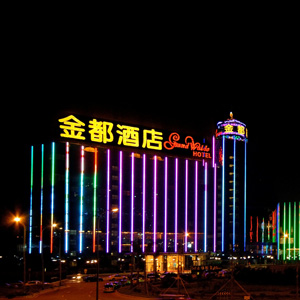
    So the taxi driver got me to my hotel, but I rather wish he hadn’t. The name, “Grand Waldo”, should have tipped me off. Seriously: Grand Waldo? In the shadow of the grandeur and surreal artificiality of the Venetian, the “Grand Waldo”, or “金都” to use its pretentious Chinese name, compensates by having the gaudiest exterior lighting in all of Macau. And that’s saying something. I had actually noticed it from the airplane on the way in, never dreaming that this was where I was headed for.

    The lobby had a touch of desolation about it, a moody silence punctuated by breathy snapping of a nailgun as some evening renovation work was carried out. At the desk, three attendants went through a check-in routine that was even more laborious and sluggish than Macau immigration.

    When I arrived at the desk the woman who was supposed to serve me was distracted first by the need to send a fax to someone, which task took about five minutes, and then by the arrival of a disgruntled man who wanted to complain at length about the crappy service. He was eventually foisted off on the assistant manager, but as I went through check in I listened to his litany of complaints. It ended with him canceling his stay in leaving in search of another hotel. Not a good sign.

    Nevertheless, I toughed it out. My room was reasonably sized, and artfully positioned in an armpit of the building such that the maximum amount of the scintillating external lighting shined right in. Fortunately there were blackout curtains.

    There was no CNN or BBC, but it did have Fox News (did you know that curvy women have smarter children and Virginia is the state with the most personalized license plates?) and, thank heavens, Al Jazeera (gunfire and political tension between Fatah and Hamas in Gaza, major fire in London). It also had Portuguese soap operas featuring attractive, heavy-breasted women in various states of emotional turmoil and scanty dress. That was worth something.

    I dialed room service. I’m pretty sure I dialed correctly because I pressed the button labeled “room service” on the phone. This led to a Kafkaesque phone nightmare in which I was transferred no fewer than six times before I got someone who was prepared to take an order for a club sandwich. 82.5 patacas after tax. The man who brought it to my room wouldn’t allow me to sign for it. I had to pay cash. He didn’t offer to make change for the pataca C-note I handed him. He just grinned and pointed at himself. I was so amazed by this display of chutzpah that he was long gone before I realized he hadn’t left the receipt for me.

    An hour later the phone in room rang. “Hi, I was staying in room 620* before, and I think I left a blue comb in there, in the small bathroom.” (It’s a suite.) “Can I come and get it?” This sounded a lot like, “Businessman gets rolled in Macau hotel” to me. I said I’d check in the bathroom. Sure enough there was a blue comb in the bathroom with bits of gel stuck to it. I told the caller to come on down and put the chain on the door.

    So he had checked out of this room and into some other room in the hotel and left his comb. Housekeeping had flipped the room, but somehow not noticed the grungy, used comb in the outer bathroom. Meanwhile, this guy was so attached to his plastic comb that he turned up his nose at the one included in the room amenity kit and came back for his.

    The icy tendrils of paranoia began to creep up my neck.

    At any rate, the comb owner was apologetic enough when he showed up at my door, and made no attempt to roll me or sell me a blow job (which does rather distinguish him from a hotel experience I once had in the aforementioned Kuala Lumpur, but more on James Bond Massage and Fullsex Escort Service and the Cantonese hookers I had to pay to go away some other time).

    So it’s all quiet now, and at least the broadband works, as I type here in the glow of Al Jazeera (which isn’t half bad).

    I have, however asked my coordinator to look for another hotel for tomorrow night.

    *Not my real room number. Like I said, tendrils of paranoia.

    Update: Hanging on my room door this morning: The Oriental Daily News, which appears to be a Hong Kong gutter rag that, judging from the layout, is designed for a readership devoted to hard hitting stories about police shootings and starlet misadventures. Still, I suppose it gives you something to read while you yank the crank on your one-armed bandit. You could just about finish a story in the time the wheels take to come up, “Bull’s eye”, “Clown” and “Dog riding a tricycle” or whatever symbols they put on slot machines these days (Imagethief is not a gambling man). I guess the name “William Moss” and the US passport didn’t tip them off.

    In all its pomp...
    In all its pomp…
  • Imagethief and the man-eating otter of Changbaishan

    I’ve posted to YouTube a video of the trip I took to Changhbaishan last summer with Mrs. Imagethief and my father. It took me the better part of a year to get around to editing it, but here it is. Changbaishan is the rugged mountain range that divides northeast China from the Korean peninsula. There is a “nature reserve” a few hours drive outside of the town of Yanji, and that’s where we went. It’s a beatiful area, but also a major tourism waystation. As always, we had a pretty good time.


    This was shot on Mrs. Imagethief’s point-and-shoot digital camera, which also has a video function. I did a few make-it-up-as-I-go standups and cut those together with other footage mostly taken by Mrs. Imagethief and some of my photographs. There was a lot of a wind noise, so I’ve subtitled a couple of spots it might otherwise be hard to make out what is being said. It’s a hair under ten minutes. Enjoy.

  • Imagethief and the hell of yurts – video companion

    Note: This video was originally presented as the companion to a long, written travelogue that is no longer posted. I reposted the video when I restored my archives because it’s much more fun than the long-winded written version. -WM

    It’s no Danwei TV, but here is Imagethief’s foray into video production. During our recent trip to Xinjiang, Mrs. Imagethief used her point-and-shoot digital camera to take about eighteen minutes of video, including several off-the-cuff stand-ups by Imagethief. We hadn’t originally intended to do anything with it except show it with our travelling companions, but after reviewing the raw footage it seemed like a waste not to share it. In a past life I used to do digital audio and video production and I’ve still got some of the tools. I’ve cut the video down to eight minutes, played with the sequence to give it some narrative coherence and added a voice over. The camera is a nifty little device, but because it’s the size of a pack of playing cards there is a bit of camera shake. Sorry about that. Nonetheless, I hope you find it entertaining, and I hope Imagethief’s singular wit survives the transition to video.

    You can also see it at YouTube. Unfortunately I don’t have a version of this video posted on a Chinese video sharing site.

  • A week in the life of a China flack

    Imagethief has recently had several e-mails from young foreigners in China who are interested in embarking upon a career in PR here. Why these students should choose such a career as opposed to, say, enlisting in the Navy as a boiler technician or applying for a research internship to the Congo is a mystery. But there is no arguing with the idealism and energy of youth.

    As a service to these eager youngsters, and anyone else with an interest, I thought I would diary a week (six days actually) in the life of a China flack. I hope the following chronology of glamour and high society will lure more talented young people (or burned out journalists) into the industry.

    Wednesday
    6:00 AM: Up early for the 8:40AM flight to Shanghai to work on new business proposal with a Shanghai colleague. Flight is uneventful. Get to Shanghai office at noon. Picked up by company driver and taken to office. Fishball noodles for lunch.

    1:00 PM: Before working on proposal, make RSVP calls to foreign media invited to attend a Shanghai roundtable event with a client’s senior global executive the following Monday. A Chiense media event is also planned. I am due back in Shanghai on Sunday for exec briefing and will stay through Monday for the event.

    2:00 PM: Within moments of finishing media calls and confirming foreign media, client’s China PR manager informs me that global office is considering canceling foreign media event. Don’t wish to do group media event for various reasons.

    Also learn that Publication That Shall Not Be Named has called client to complain they weren’t invited to event. In fact, they have been invited and one of their journalists is supposed to attend.

    While pondering how to rescue foreign media event I continue working on proposal with colleagues. Draft due following morning. Work until 2 AM with break for noodles for dinner.

    2:00 AM: Go to hotel and check in. Must fly to Guangzhou next morning. Have following dialogue with dimwit night reception clerk at hotel:

    Me: What time do I need to leave to get to Hongqiao Airport by 9:45 AM?
    Dimwit: It takes about a half hour to get there with no traffic.
    Me: How will the traffic be at that time?
    Dimwit: I think you should leave at 7 AM.
    Me: 7 AM? That seems early. I don’t have to be there until 9: 45AM. My flight is at 10:45.
    Dimwit: Oh. Then you don’t need to leave so early.
    Me: Ok. So what time do I need to leave to arrive at the airport at 9: 45AM?
    Dimwit: (Exasperated) I just told you it takes a half hour to get there.
    Me (in my head): Lissen, dickweed, I will come over this counter and smack the spikes right off your head. You said half an hour with no traffic. There’s gonna be traffic at 9 AM. You have rush hour in Shanghai, don’t you, pinhead? So what time should I fucking leave?
    Me (actually): Ok. Gimme my key.

    Clerk also informs me breakfast not included with my room. Will be 145 RMB. I go to room and crash.

    Thursday
    7:00 AM: Up early to catch 10:45AM flight to Guangzhou to conduct training for colleagues in Guangzhou office. In absence of information from hotel pinhead decide to leave at 8:45 AM.

    8:00 AM: check out and go to hotel café for breakfast. Line of thirty people waiting for tables stretches from entrance. Abandon breakfast. Get taxi to airport. During the ride, observe the following rules posted in the taxi:

    • Don’t defile the taxi inside and any signs of the taxi.
    • Schizophrenics or drunkards without a guardian are prohibited to take taxi
    • Don’t instigate the drive to violate the regulation of the passenger transport and traffic management
    • No spitting and dumping inside the taxi.
    • If making a complaint, offer concerned evidence.

    Seems reasonable.

    Ride takes exactly half an hour, just as advised by night clerk.  I think dark thoughts about strangling him.

    8:30 AM: Get surprisingly serviceable Western breakfast at Hongqiao Airport for 40 RMB.

    10:45 AM: Flight is uneventful. Short on sleep. Doze.

    1 PM: Arrive in Guangzhou. Picked up by company driver and taken to office building. Have never been to Guangzhou office.

    1:45 PM: Arrive at 70+ floor CITIC tower. Ask driver what floor it is on. “Never been,” he says. Realize he is not the company driver, just some guy they hired to pick me up.

    Stupidly, don’t have Guangzhou office phone number with me. Scan directory and spot every other PR and marketing firm in the country. Not mine. Begin to wonder if I am at correct building.

    1:55 PM: Call Beijing office and ask coordinator what floor our Guangzhou office is on. “Six,” she says. Also gives me Guangzhou office phone number. Scan directory again. No sixth floor listed. Check elevators. No elevator goes to sixth floor. Really begin to suspect I am at wrong building.

    2:00 PM: Call Guangzhou office and ask which floor they are on. “Sixty-eight,” they say. Ten minutes later, figure out CITIC tower elevator system and arrive on 68th floor. Find office.

    Receptionist orders Illy cappuccino for me. I kiss her feet and set up in spare office.

    2:15 PM: Check e-mail. Client has decided to cancel foreign media event in Shanghai. After some discussion with Client’s PR manager, decide to pitch exclusive to one publication instead of group event. Approach should allay global office’s concerns.

    2:30 PM: Make phone calls to two journalists considered appropriate for exclusive. One can’t make time. Another interested. Will check with editor next morning.

    3:00 PM: Conduct English writing training for Guangzhou office. Can’t say enough about team. Bright, enthusiastic and fun.

    Training over at 5PM.

    6:00 PM: Increasingly bad feelings about canceling on journalists already invited to client’s Shanghai media event and offering exclusive to another publication. Am giving foreign media relations training to Guangzhou team the next morning. Seems like classic media relations blunder case study in making. Don’t need that kind of irony.

    6:30 PM: Call client and recommend we treat all foreign media fairly and cancel foreign media activities completely. We will only do Chinese media event. Client agrees. Informs me that, as Chinese media only, my presence no longer required in Shanghai for Sunday executive briefing session or Monday event.

    I continue working.

    8:30 PM: Go to cheap Cantonese dinner with a colleague. Eat spicy Cantonese beef dish.

    9:30 PM
    : After dinner, catch taxi to Tian Lun hotel. Taxi takes me to Tian Long hotel. After correcting driver he tells me that Tian Lun is “100 meters” from CITIC building and berates me for duration of return drive. Makes me get out of taxi one block from Tian Lun hotel, presumably to prove point. God bless Guangzhou taxi drivers. Tian Lun actually about 500 meters from CITIC building. Have to admit, not far.

    9:50 PM: Check into Tian Lun. Get upgraded to palatial business-suite room. Collapse on bed and wallow in unspeakable luxury of largest hotel room I have ever occupied. Watch Spiderman II on HBO. Catch up on e-mails. Happy. Have good night’s sleep.

    Friday
    8:00 AM: Nice breakfast at hotel.

    9:30 AM: Client changes mind, requests my presence in Shanghai for Chinese media event after all. So much for Sunday.

    9:35 AM: Spicy Cantonese beef dish aggravates intestines. I run for bathroom at regular intervals.

    9:45 AM: Call and e-mail all journalists originally invited to foreign media event, including one still considering exclusive, and inform of cancellation. Grovel mightily in superb demonstration of foreign media relations skills.

    10:00 AM: Conduct foreign media relations training for Guangzhou colleagues. Still can’t say enough good about team there. Bright, enthusiastic and fun. And ask several very acute questions about media industry.

    12:30 PM: Intelligent questions delay end of training for half an hour. Running late. Gotta go to airport and catch flight back to Beijing. But Guangzhou director has already ordered dim sum for lunch at restaurant downstairs.

    12:45 PM: Go to lunch with director and set all-time dim-sum speed eating record. Also run for bathroom at regular intervals. Feel very rude. Seafood in tanks looks fresh and vigorous. Reminder of moribund state of Beijing seafood.

    1:30 PM: Late, late late! Catch taxi to airport. Driver mysteriously takes surface roads rather than expressway for half of journey, presumably in order to show me best of Guangzhou. Blood pressure soars. At far end driver palms road toll receipt.

    2:15 PM: Forty-five minutes to my flight. Long line. Sign at check in says, “If less than fifty minutes until your flight, check in at counter D8.” Go to counter D8. No one there. Go back to regular counter. Line has doubled in two minutes. Blood pressure soars again.

    2:30 PM: Successfully check in. Guangzhou airport is size of planet and my airplane parked on its furthest moon. Actually, second furthest. But, as there are 116 moons, not a big difference.

    2:45 PM: Reach airplane. To make Guangzhou residents on flight as comfortable as possible, climate controls are set for Guanghzhou conditions: hot and humid. Will be this way for entire flight.

    3:00 PM to 6:00 PM: On flight work on new business presentation to accompany proposal we did on Wednesday.

    6:00 PM: Arrive in Beijing on time. Home at 7PM. Have dinner with Mrs. Imagethief.

    8:30 PM: Publication That Shall Not Be Named (the one that called client before to complain about not being invited) calls client again to ask if event is still on. Client calls me to ask if I have informed all journalists that event is cancelled. I have.

    10:00 PM: Write blog post for CNET until midnight.

    Saturday
    Long, slow breakfast at home. Write two pieces for That’s Beijing. Take Mrs. Imagethief out on date.

    Sunday
    7:00 AM: Up early to catch 9:40 AM flight to Shanghai with Client. Flight leaves on time. Four-for-four with on-time flights. Not bad for China!

    10:00 AM: Check into Shanghai Salvo Hotel. Definitely not Tian Lun. Room is so small I have to step outside to change my mind. But aircon, Internet and CNN work, so it’s all good.

    12:00 PM: Note the following on a poster in the Salvo’s lobby:

    Fu Bar of the 31st floor has advanced projection and rounding sound equipments and professional mixologist. With finely arranging atmosphere you can enjoy the enthusiasm and galliardise in the football sport. Let night of world’s cup bubbles up along with air bubble of goblet.

    Contemplate accidental humor of a bar named “Fu Bar” (福吧).

    12:30 PM: Lunch with Client. Curry beef and lotus root.

    1:30 PM: Return to Salvo Hotel. Write posts for CNET and Shanghaiist.

    5:30 PM: Have briefing session for client’s visiting executive. Goes smoothly, although executive oddly reluctant to make eye contact.

    7:30 PM: An evening out in Shanghai:

    • A hamburger, quiche and two beers at Three on the Bund with a view of Pudong: 360 RMB.
    • An ice cream stick from a xiaomaibu a block off of Nanjing Rd: 2 RMB.
    • Two hours of Asiapundit’s company: Priceless.

    10:00 PM: Back to hotel. Crash.

    Monday
    7:00 AM: Up early for event.

    7:45 AM: Escort Chinese journalists from down-market Salvo to opulent fice star hotel for event. Contrast is startling. Wish I’d stayed at opulent hotel.

    8:30 AM: Publication That Shall Not Be Named calls me to ask if foreign media event is still on. With regrets, I inform them that it’s really cancelled.

    Presentations in morning go smoothly. Event room is small and simultaneous translation booth is insufficiently soundproof. Everyone in room can hear translator as well as speaker, even if not wearing headsets.

    During Q&A the wireless microphone goes out so translator can’t hear questions. Nobody wants to be the one to take one of the other mics from the panelists.

    One of my colleagues in charge of Chinese media relations doesn’t greet Chinese journalists coming in late and ensure that they have translation headsets etc. I have to prod.

    9:00 AM: After presentations we move to small room for roundtable Q&A with media. Client spokesperson gets head of steam in introductions. Translation is now consecutive. Have to gently remind spokesperson to stop every now and then so translator can keep up.

    Five-star hotel is opulent, but has shitty maintenance staff. They are repairing air ducts. Every two minutes noise like kettle drums rattles through our conference room. I tell my Chinese colleague to tell hotel staff we won’t pay for room. Banging subsides. But think it was actually for lunch break.

    Q&A goes well.

    10:30 AM: After event wrap, take taxi back to my company’s Shanghai office for meeting with Shanghai colleagues to rehearse for presentation to potential client that afternoon.

    12:00 PM: Lunch of sandwiches in conference room.

    2:00 PM: After rehearsal go to Pudong for presentation to potential client at St. Regis. Presentation goes well.

    4:20 PM: We have post-mortem discussion until 5:00 PM. I have 7:00 PM flight from Hongqiao. Gotta go. Don’t want to miss flight. Wife and I trying to have baby and today is “the” day for this month, according to sophisticated charts and graphs.

    5:00 PM: Colleagues and I pile into company car and head for Puxi. Colleagues want to be dropped at Nanjing Rd. West on way through town. Detour through traffic stretches drive interminably. Other thing stretching is bladder. Feeling effects of cappuccino, bottle of water and Diet Coke at presentation. No choice. Have to hold out until airport.

    5:45 PM: Drop off colleagues. Traffic continues to crawl. Bladder continues to stretch. Start having fantasies of relieving myself into water bottle, glove box, wherever. Kidneys begin to hurt. Begin to fear nephritis.

    5:55 PM: Finally get on Yan’an Elevated Road. Traffic improves dramatically. Bladder continues to expand. Imminent threat of catastrophic uro-nova.

    6:05 PM: On Yan’an road, spy a calico cat. It has wandered onto elevated road and is now trapped, a kilometer from the nearest exit. The cat is up on the concrete rail, wedged against the fiberglass that separates roads from nearby buildings, as far away from traffic as possible. How long has the cat been trapped there? It is probably hungry and thirsty. It has the shocked, shrunken-into itself look of an animal that has been scared for a long period of time. It is doomed. Only a matter of time before it breaks onto road and goes under the wheels of a vehicle. Saddened, due to fondness for cats. Personal troubles suddenly diminished by comparison.

    6:15 PM: Surprisingly, get to airport with forty-five minutes to spare. Fast check in (for those without baggage) is closed for first time in my experience. I ignore screaming bladder and go to normal check-in. Line moves fast. Get window seat, which I prefer.

    6:25 PM: Sprint for bathroom. Piss for centuries. I will never piss again.

    6:35 PM: Piss again.

    6:40 PM: Board airplane.

    9:00 PM: Taken off airplane due to delays caused by bad weather in Beijing.

    9:00 PM to 1:00 AM: Find power outlet in waiting room. Edit Xinjiang video on laptop. Watch Dave Chappel videos on laptop. Give thanks for laptop and habit of always keeping one or videos that I want to see on it. At 10:30 PM airport serves us a compensation meal. Could be worst meal I have ever eaten.

    Flights begin to be cancelled. No departures left on departure board. Begin to worry that I may be sleeping in airport.

    1:00 AM: Our flight is re-boarded.

    1:45 AM: Wheels-up.

    3:30 AM: Arrive Beijing. Sun starts to come up during taxi ride home.

    5:00 AM: Off to bed. Oh, magical sleep, bestow thy sweet kiss upon me.

    Tuesday
    9:00 AM: Up for conference call.

    And so on. As for getting pregnant, well, there’s always next month.

  • Coffee, tea or bleeding ears?

    With the exception of the Americans, who are in a league of their own for depersonalized airborne misery, the Chinese have done more than any other civilization to make flying as much like riding a bus as possible.

    Today’s flight, a zippy little transit between Shanghai and Guangzhou, shows how. The person sitting in front of me had his seat fully reclined and was snoring loudly while we were still on the taxiway. I briefly entertained thoughts of reaching over the top of his seat and smacking him hard on the top of the head, but I don’t know how the Chinese authorities react to cases of laowai air rage.

    But there is another thing that really drives home the bus-like nature of this flight: the in-flight movie. Anyone who has ever ridden a long-distance bus in Asia will be familiar with the bus-movie. Most Asian busses have a video screen mounted at the front of the aisle and a VCD player somewhere around the dashboard.  Moments after the journey begins the TV will be fired up and you’ll be gifted with the very latest in Hong Kong, Chinese or Bollywood output, depending upon which country you are in. (I recently got Bollywood dubbed in Mandarin on a ride between Urumqi and Turpan in west China, so the national rules aren’t ironclad.)

    Busses have loud diesel engines and appalling road noise, but don’t usually have headphones. Thus, the sound will be cranked loud enough to enable people sitting in the car behind you to hear the movie. Aside from reducing road safety, that will overdrive the already blown speakers and ensure that painful, unintelligible booming and gargling noises pummel your years for the duration of the drive. If god is against you—and if you’re taking the bus that’s a given—then the picture will suck too. So you’ll try to read, but that will prove nearly impossible under the aural assault, and eventually you’ll lapse into catatonia go psychotic depending upon your individual temperament.

    On many airplanes you can count upon having headphones available for the in-flight movie. But not on China Southern flight 3532 from Shanghai to Guangzhou. They’re showing some generic romantic comedy, all shrill female voices and goofy, galumphing men. The sound is being piped over the 737’s PA system. In true Asian bus style, it has been cranked to be audible over the sound of two jet engines, wind noise, and the nonstop rumble coming from the snore-a-holic in the seat in front of me. There is no escape.

    Oddly enough, taxis have a similar syndrome. In Beijing, most of them don’t have video screens (although, depressingly, a few do). However every taxi driver in Beijing seems to think that the first thing any foreigner wants to do once he is comfortable in the back seat is catch up on the latest radio xiangsheng act. If you’re traveling with a companion the driver will courteously turn the radio up extra loud to ensure that you can hear thexiangsheng over your conversation (it’s the only explanation I can think of).

    My Chinese isn’t good enough or fast enough to understand xiangsheng, but I can usually pick out some words and phrases. That means I get to spend my entire cab ride listening to something that sounds like this:

    甲:和谐是建立在团结的基础上的,my sister 对一个家庭、组织、团体和国家来说,如果不团结或者不够团结,自然也就难以达到和谐,生活于其间的人们也就不能感受到幸福。
    亿:由于社会中存在着困难人群,他们需要其他人的关怀和帮助,仁爱伦理要求人们在力所能及的情况下,给这些人以物质和精神上的支持 your sister?
    甲:又由于一个人在其人生旅途中难免会遇到这样那样的困难或窘境,my sister and a donkey 因而互助是对所有人都有益的道德行为。
    亿:为了实现友爱、安定、有序和公平的和谐社会,需要全体人民大力弘扬团结互助的优良美德 who’s donkey?
    甲:团结互助鼓励合作互利 my sister。有人认为,在市场经济条件下,追求个人利益就很难讲道德,只要能够获得个人利益,donkey 就可以不考虑手段是否正当 with a carrot。
    亿:社会上存在的损人利己现象,与这样的思想认识有密切的关系 with a donkey?
    甲:人与人的关系反映着一定的利益关系,虽然个人获得正当和合理的利益需求是不可剥夺的权利 vaseline,但是,这里存在着如何正确处理人与人利益关系的大问题‭ ‬fucking enormous carrot。
    亿:现代市场经济倡导竞争,your sister 但竞争不是一方完全得利,另一方完全受损,更不是用损人的方式来利己 bitch whore of all China。
    甲:Damn straight 真正的竞争应该是参与竞争的各方都获得其应得的利益 had to get a new donkey。

    That’s entertainment.

    Meanwhile, here I am on the plane, listening to an inescapable, donkey-free romantic comedy. The guys across the aisle are having a six-man party in a space designed for three people, and speaking loudly enough to compete with the movie. The man sitting behind me has just thoughtfully reached forward to close my window shade, in case the daylight is distracting me from my writing one must presume. What’s that I feel coming over me? Is it catatonia or psychosis? Check tomorrow’s Guangzhou newspapers to find the answer.

  • Imagethief and the spectral tiger: A Dongbei travelogue

    It was the same conversation I’ve had a hundred times in China. “Where do you come from? How did you learn to speak Chinese? Do you like China?” But it was the first time I’d had it buck naked in front of five inquisitive and slightly fey Chinese guys and, for good measure, my father. How did I end up in this situation? I get ahead of myself.

    ***

    “Why on earth would you want to go to Harbin?” asked my colleague Christina. ADongbeiren herself, and something of an office dragon-lady-in-training, she had me transfixed in the contemptuous, patrician gaze she reserves for people who have uttered something truly moronic in her presence. “There is nothing there. Nothing. Why don’t you take your father to Shanghai, or Qingdao?”

    I had no real answer for this, except that an American friend of mine, an old China hand of some years, had recommended Harbin as a fairly chilled-out town (in the idiomatic sense). Furthermore, my father, on his third visit to Beijing and having spent a week wading through Ministry of Health bureaucracy while consulting for an American NGO, was anxious to get out of the capital for a few days.

    Of course, it’s a drastic mistake to ask someone for tourism advice on his or her hometown. Whenever people ask me what they should do when they visit San Francisco I am instantaneously struck dumb. “I dunno”, I’ll mumble. “Get a burrito?” Fortunately another colleague, one of the few other foreigners in our office, dispelled my doubts. “Chinese people have different expectations of tourism,” he said.

    This is true. My Chinese colleagues, many of whom are from provincial towns, sacrificed their childhoods to get into elite schools, learn English, earn places at top-flight universities and come to Beijing to work in an international consultancy. Spring festival aside, when family obligations trump all else, the last way they want to spend their vacations is by humping around some provincial burg that represents everything they escaped from. They prefer to go to Shanghai, Hong Kong or Singapore for their fun. I can understand this. I grew up in San Francisco, so how much need is there for me to go to Fremont for my vacation? (The different tourism expectations of Chinese people would become something of a theme on this trip, as you will see.)

    I am a transplant to China who is trapped in Beijing most of the time. Singapore is my second home. I go to Shanghai on business all the time and I’ve been to Hong Kong. The dongbei, on the other hand, is the wild frontier to me. So off I went, wife and father in tow.

    ***

    Whenever I fly into a Chinese city I proudly ignore the inevitable car touts and head for the taxi queue. This turned out to be a mistake in Harbin, where the taxi fare per kilometer increases drastically over distance. With a 20 kuai airport road toll and the airport apparently near the Russian border, we ended up forking over 150 kuai to get downtown. For a Chinese taxi fare, that is something like Avogadro’s number. You can deal with it mathematically, but you can’t really grasp the meaning. The opening tout bid had been 120 kuai, negotiable. Bear that in mind next time you fly to Harbin. Or take the train, which puts you in the middle of town.

    We were dropped at the Modern Hotel, which is named half-correctly. It’s a hotel. There began our lesson in one the great Harbin truisms: Harbin’s average level of customer-service makes Beijing seem positively obsequious. It wasn’t 1990’s-style refusal to help white people, but more a general indifference that suggests, Ice Lantern Festival aside, the town hasn’t quite come to grips with the concept of tourism. Various people failed to help us book train tickets, make a hotel booking in Qiqihaer, find a bathroom, re-enter a bathroom-less tourist-attraction after leaving to look for a bathroom (related incidents), find some variety of dumpling not sold-out for the night, or avoid a deep-fried bizarre-dessert in favor of the green vegetables we actually wanted (different restaurants). These weren’t language issues, with two of us speaking at least some Mandarin. But if ten years in Asia has taught me nothing else, it’s taught me patience with mediocre service, so this didn’t destroy my enjoyment of Harbin.

    Downtown Harbin is exactly what you’d expect of your medium-sized, provincial Chinese city of ten million. It has one boutique-lined tourist drag, Zhongyang Road, and the rest is interchangeable, gray Chinese city. Two things stood out. First, Harbin is a town designed for surviving winter on Pluto. Where Beijing has double-paned windows, Harbin has double double-paned windows with twenty-centimeter gaps in between and hefty double-doors. It is also peppered with European-style building from its days as a Russian entrepot, adding a splash of architectural color to the standard metropolitan Chinese fare of squared-off apartment blocks and dingy shopping malls.

    Many of the Russian buildings line touristy Zhongyang Road, but you could see all you needed to see of that strip in twenty minutes. A Meters/Bonwe or KFC in Harbin looks just like one in Beijing. If you’re spending a day or two in Harbin, my advice is to ignore Zhongyang Road completely unless you are looking for a piroshki at the Café Russia 1914, or some other kind of meal. If you’re a veteran of Chinese cities (and who else would go to Harbin?), you’ll find it much more interesting to stroll around the old neighborhood just west of Zongyang Road. Many of the Russian buildings here are just decrepit shells, and gritty Harbin life proceeds unmolested by the Chinese tour groups that ramble up and down Zhongyang Road. Fascinating, grubby little storefronts line the road, and commercial life spills out onto the streets in the form of market and vegetable carts at the intersections.

    This area has many large and unlovely local apartment blocks well worth exploring. Unlike the slabs and towers of Beijing, Harbin’s blocks are designed around courtyards, and each courtyard tells the story of the prosperity of its block. Some were gleaming and tidy, with exercise machines for the aunties and uncles and nicely groomed gardens. Many were shabby, decrepit and lined with the detritus of urban Chinese life. Real personality shows through the back of a house, not the front, and I am fan of this kind of urban voyeurism. I peeked into many of the courtyards as we walked, looking for the slice-of-life dramas that tell the real story of a city: families doting on children, old people praying in solitude, middle aged men with shirts hiked to their nipples gathered around chess games on overturned oil drums, tiny shops and midden-heaps. It is far more interesting than anything you’ll find on the shopping strips.

    We did devote a little time to tourist sites, including St. Sophia’s, a century-old Russian Orthodox church, which could be lovely if the interior paintwork was tidied up. Plus it wouldn’t kill the city fathers to add some English to the captions on the otherwise interesting display of historic Harbin photographs inside.

    I had broken one of my own travel rules the night before and eaten a very spicy meal prior to traveling. The north end of my gastrointestinal tract loves spicy food, but the south end is somewhat less resilient. My enjoyment of the fading architectural grandeur of St. Sophia’s was diluted by the sudden liquefaction of my colon and resulting immediate need to find a bathroom. 25 kuai to get into St. Sophia’s church does not get you into St. Sophia’s toilet, it turns out. Furthermore, the spotty youth guarding the door told me that I wouldn’t be allowed back in if I left. That left me with two options: a possibly sacrilegious and definitely illegal unloading in the church rotunda, or cutting short my visit and going in search of a Harbin public toilet.

    Decorum won, but Harbin service gap loomed again. “You can’t shit here,” growled the lao taitai minding the public squats when I asked to buy a packet of tissue. Jeez, it’s a toilet. If not here, where? At that moment I realized how much Beijing’s abundance of fully functional public toilets has spoiled me. I promptly broke the record for a foot-transit from St. Sophia’s to the Modern Hotel, and my room’s semi-modern toilet.

    Refreshed, we strolled down to the bank of Harbin’s kilometer-wide Songhua (pine blossom) River to see the unfortunately named Stalin Park. The park, a long, riverfront promenade, is home to the famous flood control monument commemorating the heroic efforts of the men who held the banks of the Songhua against the raging waters of 1958.

    It was a hot, July Saturday and approximately the entire population of the city was piling into the river. Thousands of people were splayed along the concrete steps that line the downtown side of the river, treating the strip like a beach. Whole families had stripped off to their underwear and were splashing in the unwholesome but cool river water. Children careened around with water guns and cotton-candy, a volatile and sticky combination. Balloon and pinwheel vendors worked their hypnotic charms on toddlers, and aunties sold two-kuai tickets for the boats that ply the river between the promenade and the far-bank’s Taiyang Park. Smoke from roasting chuan drifted through the trees. It was a tremendously congenial example of the Chinese ability to turn any public park into a block-party.

    Judging from the enormous crowd, the flood control monument was a renowned local attraction. While bronze flood controllers gazed forth resolutely from the plinth with socialist fervor, hundreds of people watched a fountain squirt and pulse in time with tinny, martial music blaring from loudspeakers mounted on a surrounding ring of Romanesque columns. Perhaps during Harbin’s legendary winter it becomes the glacier-control monument.

    As we watched the plaza near the flood control monument, we noticed a slow infiltration of lao taitais and lao gonggongs in matching, white T-shirts. It looked like a geriatric street-gang was casing the area. In my head I could hear the Jets theme from West Site Story. This was appropriate, because suddenly they reached critical mass, a squawky drum/cymbal/pipe trio burst into life, and we were treated to Saturday Night Fever Harbin-style with a display of Chinese fan-dancing. An ornately-coiffed queen-bee in a black, sequined pantsuit, and her consort, resplendent in green, dominated the event with conspicuously smoother moves than their arthritic colleagues. All this took place before a surreal, bronze statue of a Sino-Greco-Roman Adonis in conspicuously modest, bronze shorts slaying a Chinese dragon. Another monument to either flood control or sensible underwear. In Harbin, both are important.

    ***

    When in Harbin, it is mandatory to visit the Dongbei Siberian Tiger Forest, a kind of tiger theme-park where you can ride a bus through tiger-infested enclosures and gaze in wonder at the majestic beasts. To get to the Siberian Tiger Forest we took one of the two-kuai boats across the river to Taiyang Park, from which it is a fifteen-minute taxi ride to the tigers. The boats are steel rustbuckets that tie up at the riverbanks in droves and shove-off when full. Most of them look as though they’ve sunk and been salvaged repeatedly. They are clearly designed to bang off of each other when mooring and casting off. I am sure if the Songhua River ever dries up, the bottom will prove to be littered with the corpses of these boats. (The entire scene at the jetties would be instantly familiar to anyone who has ever been to Singapore’s Changi Point to catch a bumboat to Pulau Ubin.)

    Taiyang Park is a kind of sterile, Russia-land amusement park that seems to cater either to Chinese who want a taste of “motherland-lite” or to homesick Russians tourists who have no better alternative. There is a lot of Russian on the signs. The most authentically Russian thing we witnessed was provided by a Chinese woman who was drunk beyond all sensibility and sprawled on the grass in full, keening sob with her skirts indelicately hiked up to her waist and a husband or boyfriend frozen in embarrassed inaction beside her.

    The official propaganda for the Tiger Forest claims that it is breeding tigers and training them for reintroduction to the wild. This is utter balls. It is breeding tigers and training them to entertain tourists. At the Tiger Forest you can arrange in advance for various live animals to be hurled to the tigers for your entertainment. The price list begins with chickens (40 yuan) and escalates through ducks, goats and live cattle (a bit rich at1600 yuan). We were too cheap to arrange any livestock-hurling of our own, so we counted on the other tourists on our bus to do the right thing by subsidizing our entertainment.

    But before we were treated to the action we had to wait for our tiger-bus to be ready. The waiting room was also a museum and, naturally, a gift shop where you could purchase any of a staggering assortment of tiger paintings, stuffed tigers, tiger tchatchkes and ice cream bars. But the centerpiece of the souvenir-emporium cum educational display was an enormous, tiger skeleton pickling in a glass vat of formaldehyde. Ragged bits of flesh still clung to the spectral tiger remains, which gazed through a brown haze of preservative. It was surreal in a way that only threadbare, Asian tourist attractions can be. If you’ve ever been to the Zoo in Ho Chi Minh City, you’ll know what I’m talking about. I’m still not sure if it was simply a poorly preserved biological specimen, or a tremendous example of slyly provocative modern art.

    It was time to safari. We bundled in with eight or ten Chinese tourists and I had visions of Jurassic Park as our bus made its way through large, electric double gates into the enclosure. Fortunately gambling on the blood-lust of our fellow tourists paid off.

    The safari park where you pay to see live animals fed to other live animals seems to be a peculiarity of Chinese tourism. The show is definitely not for PETA members or sensitive bunny-hugging types. The whole time we were driving through the tiger enclosures we were shadowed by an armored Land Rover filled with plastic containers of live chickens and ducks. Whenever someone was ready to stump up for a feeding, he would fork over the bills to the driver, who would radio the Land Rover and specify which animal was to be hurled to its doom. (I’m not sure what they did if you ordered a cow. You might want to phone ahead if you want that.)

    We were treated to two spectacles. The first was scarcely ten meters into the enclosure, when we stopped in the midst of four or five lazy looking beasts. The Land Rover drove up beside us, and the tigers reacted exactly the way my cats do any time I move towards the kitchen. The driver fished a live chicken out of one of the plastic bins in the back and unceremoniously tossed it up through the window on top of the car. The chicken barely had time to register its predicament before the largest of the beasts was on top of the Land Rover with a mouthful of live bird. You can see why chickens are cheap. They don’t last long.

    We got another burst of excitement when one of the other tourists decided to front up another 100 kuai for a duck (an outrageous price for a live duck in Harbin considering 50 kuai will get you a whole roast duck in Beijing). We pulled up by an artificial pond surrounded by several somnolent tigers and the Land Rover stopped on the opposite side. The driver stepped out, duck in hand, and lofted the unfortunate bird down into the water. The tigers were completely indifferent. Only after the bus driver leaned on the horn and threatened to run over several of the slovenly cats did they rouse themselves into grumpy hunting action. Now we got suspense. Unlike the chicken, the flightless domestic duck had plenty of time to see what was coming. It went around the pond in increasingly frantic circles looking for a tiger-free stretch of bank as the stripey noose slowly closed around it. Finally one tiger took to the water, only to be robbed of its prize as it pinned the duck against the bank where another, more strategically positioned tiger jumped it. I wavered between guilt and fascination the entire time. It was actually a pretty good show.

    And that was pretty much the end of the excitement at the tiger park. No one felt like stumping up 600 for a goat, to my disappointment. We did stroll through a series of elevated catwalks (no pun intended) with our fellow tourist, from which we could watch tigers frolicking. The most interesting thing was watching a few tigers roughhousing in their small, concrete swimming pool. The pool was absolutely infested with frogs. Damn, I remember thinking, what a shitty place to be a frog.

    ***

    The next morning we set out for Qiqihaer to visit the Zhalong nature reserve, home of the giant, migratory red spot cranes. The two-hour train ride offered a splendid view of the desolate, industrial plain of Daqing. It was covered with decrepit oil wells dipping moodily for the remains of China’s vanishing oil, enormous coal-fired power plants, and the swamp itself, which we traversed for over an hour. Apparently the Zhalong swamp is the second largest wetland in the world, after Russia’s legendary Pripet Marshes. Much of the train ride was occupied by a lengthy debate among our fellow, Chinese passengers about how we should get from town to the nature reserve. The consensus was that we should catch an indeterminate bus from behind an indeterminate supermarket near the station.

    Qiqihaer’s old train station is a true masterpiece. It’s a gorgeous, brick, Art Deco building dominated by a clock tower and two enormous sets of red, Chinese characters mounted on the roof: “Long live the communist party” on one side, and “Long live Mao Zedong thought” on the other. The new train station, next door, is ghastly, 1970s neo-Stalinist monstrosity with far less personality. Having looked up the CITS travel office, we took a taxi ride across Qiqihaer to the nearly glorious Hubin Hotel, next to Qiqihaer’s Longsha Park. Qiqihaer is an ammunition-manufacturing center for the PLA. It is broad and flat, and has little scenery to recommend it. It is, however, littered with Army surplus stores all featuring marquees with pictures of sexy women in military garb. If you like this sort of thing, by all means, visit.

    After lunch at the hotel, the man who ran the travel office was thrilled to help us book transportation out to the Zhalong Nature Reserve and a night’s lodging at the Zhalong Guesthouse, thus sparing us from the alleged bus and uncertainty over where we would spend the night. He warned us that the guesthouse would be rough accommodation.

    A one-hour taxi ride took us to nature reserve, which occupies a spit of land that projects into the swamp. To call the Zhalong Nature Reserve surreal is to stretch the definition of the word “surreal” to its outermost limits. A series of decrepit, squared-off office buildings surrounded a car park dominated by a space-age, Soviet era, stainless-steel statue of cranes in flight. The guesthouse itself was a charmless cinderblock construction featuring exactly no other guests, which really should have served as a warning. We were given two rooms featuring no fans, no air conditioning and windows that could not open.

    Or rather, in each room one window could open and one window could not. But the window that could not open was the only one with a screen. More on this later.

    Ten minutes walk away from the guesthouse and office complex was the “nature reserve” proper, which consisted of rows and rows of cages featuring captive red-spot cranes. While we wandered around gazing at the miserable looking caged birds we were treated to the brief spectacle of the one and only flight of wild cranes we would see while we were there. They didn’t linger.

    The keepers explained the system to us. Every day at 10 AM, the captive cranes are released. They fly one or two laps around the nature reserve, and then return and wander around freely for a while so people can photograph them. While we were there, a chubby Chinese tourist was having a loud and abusive argument with the keepers because they (remarkably) would not accept his bribe to have a private flying for him then and there. He and his two friends were the only other visible tourists.

    With no crane-flying to watch until the next morning, we walked further along a little raised path leading into the swamp, toward a distant hut inhabited, one must presume, by some kind of swamp man. (There was smoke from the chimney.) Swamp-man’s special powers immediately became obvious. He is invulnerable to mosquitoes. This is clear because by the time we were fifty yards down the path, my father and I were covered with mosquitoes.  This is not an exaggeration. Despite a dusting of repellent, every inch of exposed skin, and every inch of clothing had mosquitoes on it. And it wasn’t even dusk. My wife, who is gifted with something called “intelligence” (I’ve read about this; it sounds useful), had seen this coming and turned back. My father and I literally sprinted back toward the cages, swatting madly. Both of us were speckled with little splotches of blood where we had smacked feeding mosquitoes.

    So an exploration of the swamp was out. We decided on an afternoon stroll to the local village instead. That also required a two-kilometer walk through the swamp, but along a much wider, elevated dirt road. Nevertheless, on the way out of the nature reserve grounds several people asked us the same ominous question: “Aren’t you afraid of the mosquitoes?”

    On the way out of the nature reserve grounds we saw one lone, un-caged crane standing amidst the tall grass behind the security office. A real wild crane sighting! We were elated! “No,” said the cheery evening security guard, an aging, former fisherman who earned 300RMB a month manning the guard post at night, “He’s not wild. He can’t fly. So I take care of him.” Yes, we had spotted a pet crane. David Attenborough would be proud.

    The walk out toward the village was surprisingly beautiful. The sun was getting low and orange, and the light was turning warm. Away from the trees and nature reserve buildings you could appreciate what a genuinely enormous, flat, uninterrupted space the swamp was. It stretched off toward the horizon in three of four directions, an endless sea of soggy sawgrass interrupted only by the very occasional structure or stand of trees.

    A bus happened by and took us the rest of the way to the surprisingly tidy and prosperous looking village. Many of the residents must either fish or work at the nature reserve or some of the nearby hotels and restaurants that serve it. People were surprised to see us, and many, suspecting that we had taken leave of our senses, asked us the now common question about whether we had the good sense to be afraid of the mosquitoes. One mother wrestled her children into a row so I could take a group photo. Another pair of mothers was charmed when I showed them the digital photo I had taken of one of their young sons on a tricycle. “Can you take it out of the camera?” one asked. I had to admit that, at that moment, I couldn’t. But I made a mental note that a small battery-powered printer or Polaroid camera might be a nice icebreaker in some of China’s remoter locations.

    The sun was getting seriously low and those questions about the mosquitoes were weighing on our mind. It was going to be a long and itchy walk back through the swamp. Fortunately, a family of peasants offered us rides back to the nature reserve in a xiao beng beng, rural China’s ubiquitous, two-stroke, three-wheeled utility vehicle. We all clambered into the back and had the least comfortable motor-vehicle ride of our lives. Xiao beng bengs (I think they are named for the noise the engine makes) have no suspension. I crouched painfully in the rear with my knees bent to absorb the otherwise spine-shattering jolts. The family was hauling a load of live fish to market and every bump splattered me in icy fish water. Worse, we were moving only incrementally faster than the mosquitoes, and I still picked up a fair few bites on the way.

    Back at the nature reserve we stopped for a chat with guard and his defective pet crane. He was a friendly soul, and shared his last three cigarettes with us. In my travels in Asia poor people have often offered me cigarettes in lieu of any other available gesture of hospitality. I seldom smoke, but in those situations I usually accept, as an icebreaker and show of collegiality. Plus, it kept the mosquitoes away. I couldn’t help but think about 300 RMB a month, though, and what share of his monthly income a pack of cigarettes must have represented. After dinner at the nature reserve’s small but cheerful restaurant (the only cheerful thing at the reserve), I bought a pack of Chunghwas for the usurious price of 60 RMB and took them back to the guard. Of all the presents I have ever given in my life, this one the elicited the most spontaneous and genuine expression of joy that I have ever received. And people say that cigarettes are bad.

    That night I was in danger of sweating to death. My wife and I were in a threadbare room with three beds. Although it was a dry night, a slow leak somewhere in roof above was dripping down onto the middle bed. It obviously hadn’t been used in a while, since the bedding and mattress were thoroughly discolored by the leak. We desperately wanted to open the window and get some air, but we were dissuaded by the constant drumbeat of insects against the closed windows. The sheer volume of insect life trying to break into our room sounded like rain against the glass. A fair number of insects were already in the room, and my attempts to read were constantly interrupted by small, wriggly flying things bouncing off the reading light and landing in my hair, on my sheets and on my book. Having spotted a few sinister looking millipedes on the wall, I had already shifted my bed away from all surfaces. I would have levitated it if I could.

    The handle had broken off the one window with a screen. Finally, in danger of heatstroke, we asked the help (and I use word loosely) if there was any way to open the screened window. They produced the snapped-off end of the handle. After some fiddling and swearing I actually managed to get the window open, admitting a welcome breeze but also making the rain of insects sound ominously closer. The window in my father’s room was beyond saving and he had to roast. Finally, unable to read any longer for the constant stream of bugglies landing on my head, I turned off the light.

    The next morning, in anticipation of the flying of the captive cranes, we were out at the cages at 9:00 AM. At 9:30 AM we were joined by busload after busload of Chinese tourists. At 10:00 AM the doors of the cages were opened and the cranes burst forth in a mighty flock. Captive or not, they are awesome to watch in flight. With their two-meter wingspans and the primordial swamp as backdrop it was like watching an orbiting flock of albino pterodactyls.

    After two slow laps, the cranes landed in front of the cages and began pecking for frogs at the grass at the edge of the path. And the tourists waded in. These are some of the most tolerant birds I have ever seen. People scrambled among them, arranged themselves for family photos in front of them, herded them into position for pictures, and were generally louder and squawkier than the birds were. With one or two alarming, flappy exceptions, the cranes were completely indifferent.

    An hour later, the birds were herded into their cages, the Chinese tourists left, and we were alone with mosquitoes again.

    And here, then, is the great difference between Chinese tourists and western ones. We are obsessed with “getting back to nature” and seeing things that are unspoiled, or at least appear unspoiled (there is often a difference). We want the “authentic” and the “un-touristy”. We want to wander the local village, taste native life, and observe great creatures roaming their natural habitats. We want to scowl dangerously at other westerners who dilute our sense of cultural isolation.

    The Chinese want a predictable spectacle, and then they want lunch.

    I offer no criticism. Given that I am all for keeping animals in humane circumstances, the Chinese know what they want, and they go for it. We should get over our hypocrisies about it. We western tourists are as picky and spoiled, in our own way. We are as demanding of spectacle, but we camouflage it better behind our obsession with luxury eco-tourism and our treating of impoverished locations as adrenaline thrill rides. As an amateur photographer, I intrude as a matter of course. I just intrude on people instead of animals.

    Having had our fill of Zhalong, we took a bus back Qiqihaer and caught the train back to Harbin.

    ***

    In Harbin we had a couple of hours before our sleeper back to Beijing. My wife desperately wanted a shower before the train, and it didn’t sound like a bad idea to me either. During our travels she had noticed several buildings called 洗浴馆 (xiyuguan). After a little research, she determined that this was someplace where a shower could be had. As luck would have it, there was a large one in the building across the plaza from the Harbin train station.

    It was, of course, a large Chinese bathhouse, of the kind that will be familiar to anyone who has seen the Chinese film Shower. I had never been into a Chinese bathhouse before. I hadn’t even seen Shower at this point, so I really had no idea what to expect. We paid our fees and my wife headed for ladies’ side my while father and I headed for the gents.

    The whole place had an over-wrought and slightly chintzy Greco-Roman décor, and a whiff of KTV lounge and prostitution. That put me well on edge from the start, and my unfamiliarity with the system made me feel even more vulnerable and awkward. The moment we were inside the locker room we were surrounded by squads of young, Chinese men dressed only in terry-cloth shorts and sandals. They tried gamely to nurse us through the process. With their cajoling I undressed, halting at my underwear. I don’t normally have a nudity taboo, but there were far more people involved and far less privacy than I had envisioned. “You have to take everything off”, said one of the boys. “Everything?”
    ”Yes, everything.”

    Gulp.

    So I took off everything except for plastic slippers and a bracelet that had my locker key and a token good for a massage attached. Being buck naked in an unfamiliar building in Harbin with all my possessions in a flimsy locker and a squad of nearly naked, teenage looking boys around me was making me a little squirrelly. But I put on my game face and flapped my way into the shower room desperately clutching a small, complementary bag full of single-use toiletries, with which I tried to obscure every sensitive part of my body. The shower room had the same pseudo-classical décor, three large, heated pools in the center, and rows of open shower cubicles and dressing-room style vanity counters around the edges. A few other men were in the pools or showering or grooming in front of the mirrors.

    So I took a shower. I gather foreigners aren’t regular customers of this bathhouse. As I was toweling off, still naked, I gathered a crowd of customers and attendants who asked me many of the usual questions about where I learned to speak Chinese and how I liked China. I learned that my Chinese skills atrophy a bit in this situation. As do a couple of other things. As I headed toward the locker room the attendants anxiously explained that I hadn’t had my massage yet. In my vulnerable state, that was a bit more than I was prepared to take, so I demurred with the excuse of a train to catch. A wiry man, who had for some reason been allowed to keep his underwear, immediately asked me, “Can I have your massage token?” I was only too happy to make his day.

    But, really, there was no reason to be anxious. It was a bathhouse. Nothing more. After I thought about it, I realized that my discomfort was mostly the result of unfamiliarity. I didn’t know what to do, where to go, or what to expect. Next time I’ll be better prepared. And were I to find myself in the same situation again, on the road and in need of a scrub, I wouldn’t turn up my nose at the local bathhouse.

    Of course, if the attendant offers me a hand-job after the massage, I’m outta there.

    And so, freshly scrubbed and relaxed, we caught the night sleeper back to Beijing. It was a good trip. But, then, they usually are.

  • Why I empathize with the WSJ’s American expats in Chongqing

    An interesting discussion broke out today on The Peking Duck, in Richard’s post on a Wall Street Journal article on the travails of an American expatriate family living in Chongqing. There was a fair bout of criticism of the family for insulating themselves from Chongqing and China and for moaning about the difficulty of living in Chongqing even as they live all-expenses-paid luxury.

    It’s worth reading the article, posted here on Howard French’s “A Glimpse of the World Blog”. You can also go read the extract on Richard’s blog.

    It made me think a bit about how I perceive “expats” and the expat lifestyle. I spent nine years in Singapore, where only my first job, which lasted for one year, was on an “expat package”. I was pretty well localized by the end of my stay (married to a Singaporean with more Singaporean than foreign friends). In Singapore I became completely contemptuous of foreigners who isolated themselves. But Singapore is a completely accessible city: wealthy, modern, English-speaking and with all the Western comforts you could ever hope to find. (In fact, Singapore often comes in for the opposite criticism, that it isn’t Asian enough, although I think only people who don’t know where to look make that claim.)

    But when I think back to my arrival in Singapore, even it was difficult enough at the time. I remember how thrilled my business partner and I were when we discovered a mass-market Italian restaurant. I remember how akward I felt on public transportation for many weeks. I remember how long it took me to feel like I knew my way around the city. I remember how many dumb mistakes I made managing my staff, and how long it took before I started having good, Singaporean friends.

    And that’s the thing about culture shock. It doesn’t really matter what the amenities are, or if the language is the same. There are degrees. You could be an American moving to England and still be culture shocked. You could move from California to New York and be culture shocked. You could damn well move from San Francisco to Iowa and be culture shocked. It might be less severe than coming to Asia, but it would still happen. And different people with different motivations will react differently to the experience.

    I came to China because I wanted to engage with it. I wanted to feel what it was like, and talk to Chinese people and “have a cultural experience”. I specifically sought out the feeling of discomfort and displacement that I first had when I got to Singapore because I missed the thrill and challenge of discovering someplace new. It has been tremendously rewarding, but also difficult. I invested two years in learning Mandarin before I arrived. I quit a good job to come here and arrived with no guarantee of work. My long-term future will be in Asia, and I will need to have some experience in China. I had every incentive to get into China.

    And yet, even as an Asiaphile with nine years in the region, it was difficult when I arrived. Classroom Mandarin got me almost nowhere on the street. I was scared of the bus, scared of the supermarket, intimidated at the thought of trying to speak to people and generally completely overwhelmed. And I was in a language program surrounded by other Westerners.

    Even today I still seek my Western comforts. I live in an international apartment with cable TV. The Internet is my lifeline. I damned well beat a path to the local Jenny Lou’s because I am incapable of giving up Western breakfasts. And I consider myself pretty culturally resilient.

    Now, what if I had no experience in Asia and no emotional investment in getting under the skin of China? What if I was here solely for professional reasons and knew I was going to leave in two years? And what if I was in Chongqing, a city far less accessible to foreigners than relatively cosmopolitan Beijing? And what if I was desperate to socialize my young Children as Americans?

    I’d probably grow a bunker mentality as well, and concentrate on emerging unscathed. And that’s why I find it hard to criticize the woman in the story.

    Sure, I think it’s a wasted opportunity to come to China and not engage with it as deeply as possible. I love it here. But not everyone seeks the same opportunities and experiences as me. And I can’t be too critical of that.